

Should You Rely on GMAT Superscoring for MBA Admissions?
If you’re looking for advice on how GMAT superscoring should affect your MBA applications, this article is for you.
GMAT superscoring went live in August 2026, and since then, MBA programs have slowly said more about how they’ll use superscores in the 2026-27 application cycle.
The punchline: GMAT superscoring shouldn’t be a core part of your admissions strategy. Most MBA programs haven’t chosen a clear stance on superscoring, and a surprising number of top programs have declared that they won’t consider superscores at all.
Relatively few test-takers earn superscores that are meaningfully better than their best single-sitting score, anyway; pair this with schools’ reluctance to use superscores, and you have little reason to rely heavily on them.
Not sure if your target schools accept superscores? Check our database of over 950 programs across the Americas and Europe to find out.
Pick a school to see its Superscore policy.
We do our absolute best to keep this up-to-date and accurate, but there’s always a chance we got something wrong. Please make sure to double-check any information before relying on it.
When GMAC first announced superscoring back in June, we had predicted that superscoring wouldn’t be a big deal, at least not in the short run. Now that we have some data, we can say more definitively how a superscore might affect your chances in the current admissions cycle.
A Quick Recap on How GMAT Superscoring Works
If you’ve taken the current GMAT more than once, GMAC automatically combines your highest Quantitative Reasoning, Verbal Reasoning, and Data Insights section scores from across those attempts into a single total on the usual 205 to 805 scale. It shows up on your official score report as an extra data point, along with the dates of each section score that your superscore is composed of. You can’t opt out of it, and it only draws on scores from the current edition of the exam. Your superscore does not have its own percentile ranking, either.
If you’d like to learn the full mechanics of superscoring, visit How GMAT Superscoring Works, or watch the video below.

Most Business Schools Aren’t Using GMAT Superscoring
Since the release of superscoring, we’ve kept tabs on what schools are doing with superscoring. We recently looked at over 440 programs across the Americas and Europe to see what each one’s stance was on superscores. Here are the results:
- 48 programs say they won’t use it, at least for this cycle.
- 16 say they’ll consider it as one data point among others.
- 377 programs haven’t said anything about superscoring at all.
Among the schools who have provided an outright “no” to superscores are recognizable names, like Booth, Stanford, Columbia, Kellogg, and Tuck.
Not every school has announced a policy, and we expect more announcements next year, after the 2026-27 application cycle plays out. As of right now, those who have spoken up have, for the most part, said “no thanks” to superscoring.
If you happen to be applying only to programs that consider superscores, then sure, it might make sense to take it into account as you think about retakes, but relatively few students will be in this position. Even then, I’m not sure it’s wise to focus on it — read on to learn why.
Your Superscore Probably Isn’t Much Higher Than Your Best Score
Even if you’re planning to apply only to schools that accept superscores, here’s something you should consider: for most people, your superscore and your best single-sitting score are pretty much the same number.
Superscores are only higher than single-sitting scores if your section scores vary wildly from one attempt to the next. For example, imagine that you perform wonderfully on quant and verbal on your first attempt, but massively underperform on Data Insights. You’d benefit from superscoring after your second attempt if you nail Data Insights – but only if your quant or verbal score declines significantly.
Here’s an illustration of a more realistic score improvement:
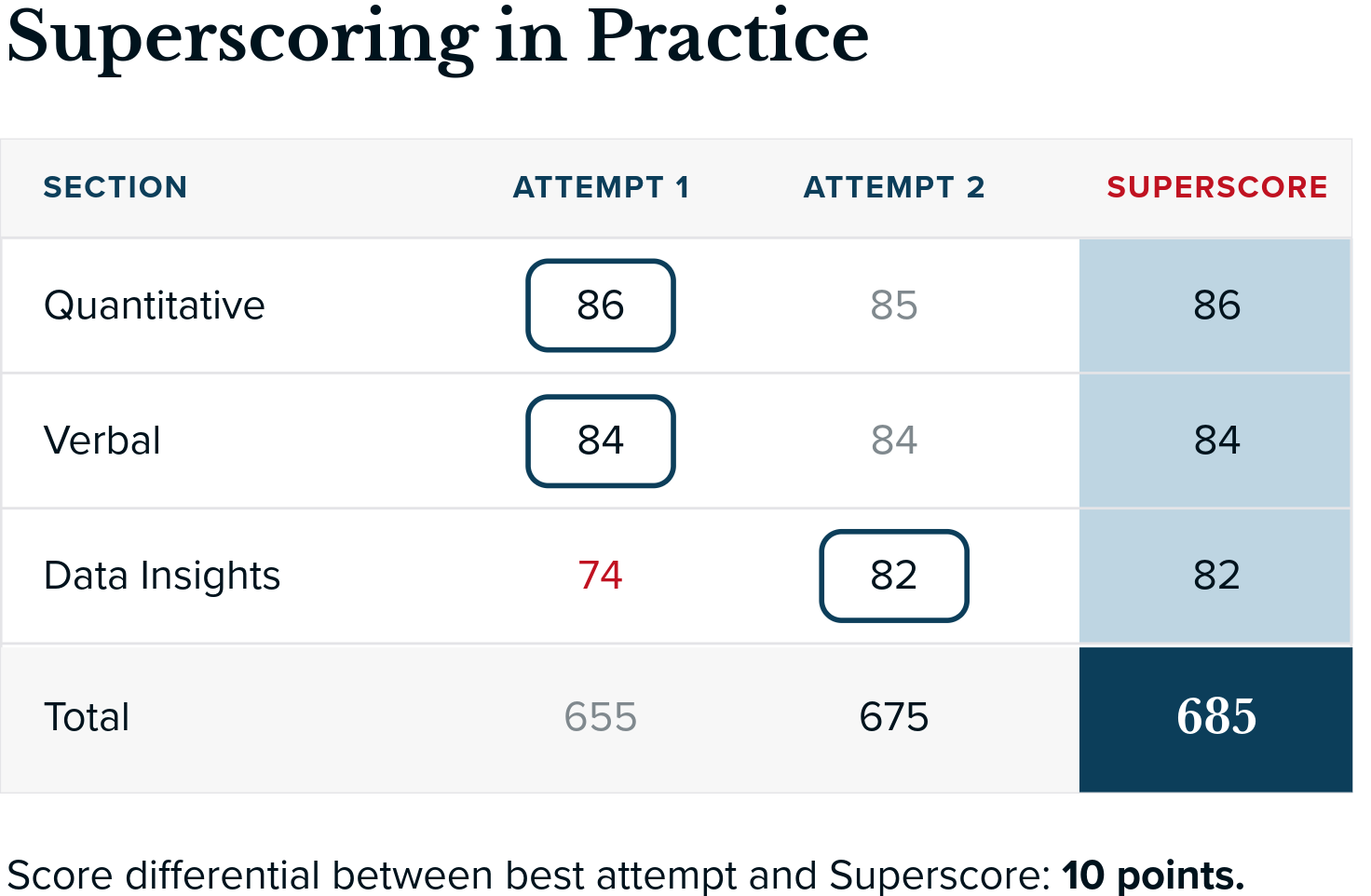
Sample test scores, illustrating the effectiveness of superscoring.
It’s not at all unusual for a student to struggle disproportionately on one section of the exam, and then improve it on subsequent attempts – but when that happens, students usually stay relatively steady on the other two sections. According to GMAC’s own data, it’s rare for a student to ace a section that was previously difficult for them, but then do terribly on sections that they’ve previously completed successfully.
The bottom line: superscoring rarely moves the needle by more than a handful of points. If your plan is to take the exam repeatedly to assemble a great superscore, the numbers suggest that it probably won’t do much for you.
Schools Already See the Whole Story
Another thing to keep in mind: admissions committees have never evaluated GMAT scores in isolation. Superscoring isn’t going to change that.
If you’ve taken the GMAT more than once, your superscore will appear on your score report with the dates of the attempts that produced each of your best section scores. The school is automatically getting context on how many times you’ve taken the exam, and they’re going to keep that in mind.
To be clear: schools have no issue with you retaking the test. It shows drive and a willingness to put in effort, which is always a good thing. But if it’s obvious that you’ve taken the exam repeatedly, while a competing candidate has written in her optional essay that she could only afford to take it once, the committee will consider that context when choosing whom to admit.
In other words, MBA programs are sensitive to the fact that some students can only afford one attempt, while others have the resources for multiple attempts. So even if your superscore is quite a bit higher than your best single-attempt score, it might not provide a proportionate boost to your admissions odds.
Please Don’t Try to “Game” the GMAT Superscore
We’ve said this before, but it’s worth repeating, since we get questions about this constantly: no, you should not just focus on one section at a time to engineer a higher superscore. It doesn’t make any sense, it doesn’t work, and it’s a really bad look. Every superscore is accompanied by at least one single-sitting score, so admissions committees can easily see that you tried to game the system.
GMAC repeats this sentiment in their own FAQ, which encourages candidates to aim for their best section and total scores on every attempt, partly to avoid spending more time and money than they need to.
Finally, GMAT attempts aren’t unlimited. You can take the GMAT 5 times in a rolling 12-month period, and each one costs you an exam fee and a few weeks of your life. Spending all that time, money and effort on a section-by-section scheme that admissions committees can see through probably isn’t the wisest plan.
What You Should Actually Do About GMAT Superscoring
Keep it simple: do your best on every section every time you take the exam. If you underperformed and you think you can do better, go retake, the same way you would have before superscoring was launched.
If that results in a strong superscore, great. If one of your schools takes it into account, that’s also great. But don’t plan on burning your time and money on retakes in pursuit of a shiny superscore, because the superscore itself is very, very unlikely to affect your admissions outcome.
The retake decision itself is what truly deserves your attention. Was a low section score (or overall score) the result of a bad day, or a sign that your prep isn’t quite working? Superscoring can’t answer that question for you, but a careful look at your detailed score report can. For more advice from us on that, check out How to Read Your GMAT Score Report, or book a consult with us.
FAQ: GMAT Superscore and Retakes
Do business schools accept the GMAT Superscore?
Some do, most haven’t said, and a sizable group – including Stanford, Booth, Kellogg, Tuck, and other elite programs – has said no. Of the 441 ranked MBA programs in North America and Europe we examined in early October 2026, 16 said they’ll consider the superscore, 48 said they won’t use it, and 377 had no stated policy on superscores. Check each school’s admissions page before you count on being able to use superscoring.
How much higher is a GMAT Superscore than a single score?
The answer to this depends on your performance, but generally, the gap between your superscore and your best single sitting is usually small.
Should I retake the GMAT to improve my superscore?
Retake the GMAT if you underperformed and believe you can do better in a full sitting. Don’t retake just to increase your superscore; most schools aren’t using it, and the ones that do will see how many attempts it took.
Can I send only my GMAT Superscore to a school?
No. You’ll still send at least one single-sitting score, and the superscore (if you have one) is attached to that report automatically, along with the dates behind each of your best section scores.