

How to Read Your GMAT Score Report
After your GMAT, you’ll receive a score report full of charts and graphs telling you what happened on your test. Some of that information is useful, and some of it isn’t.
Over the years, we’ve reviewed thousands of our students’ score reports and learned which metrics actually matter and which ones don’t. Below, we’ll walk you through the parts of your score report that are worth paying attention to. If you’re still getting oriented to the exam’s scoring, start with this article.
What Is the GMAT Score Report?
Immediately after you finish the exam, you’ll see your unofficial score on screen. Your official score will appear in your mba.com account a few business days later, although the process can take up to 20 days. For the full timeline, see our article on how long it takes to get your scores.
The detailed score report is where the real analysis begins. It shows which questions you answered correctly and incorrectly, how long you spent on each question, and how many answers you reviewed in each section. Some of this information is presented in ways that aren’t immediately intuitive, so here’s how to make sense of it.
Look for Bad Starts and Finishes
The first step is to check for bad starts and bad finishes. The Question Performance and Time Management section of your score report shows whether you missed a disproportionate number of questions at the beginning or end of the Quantitative Reasoning, Verbal Reasoning, or Data Insights sections.
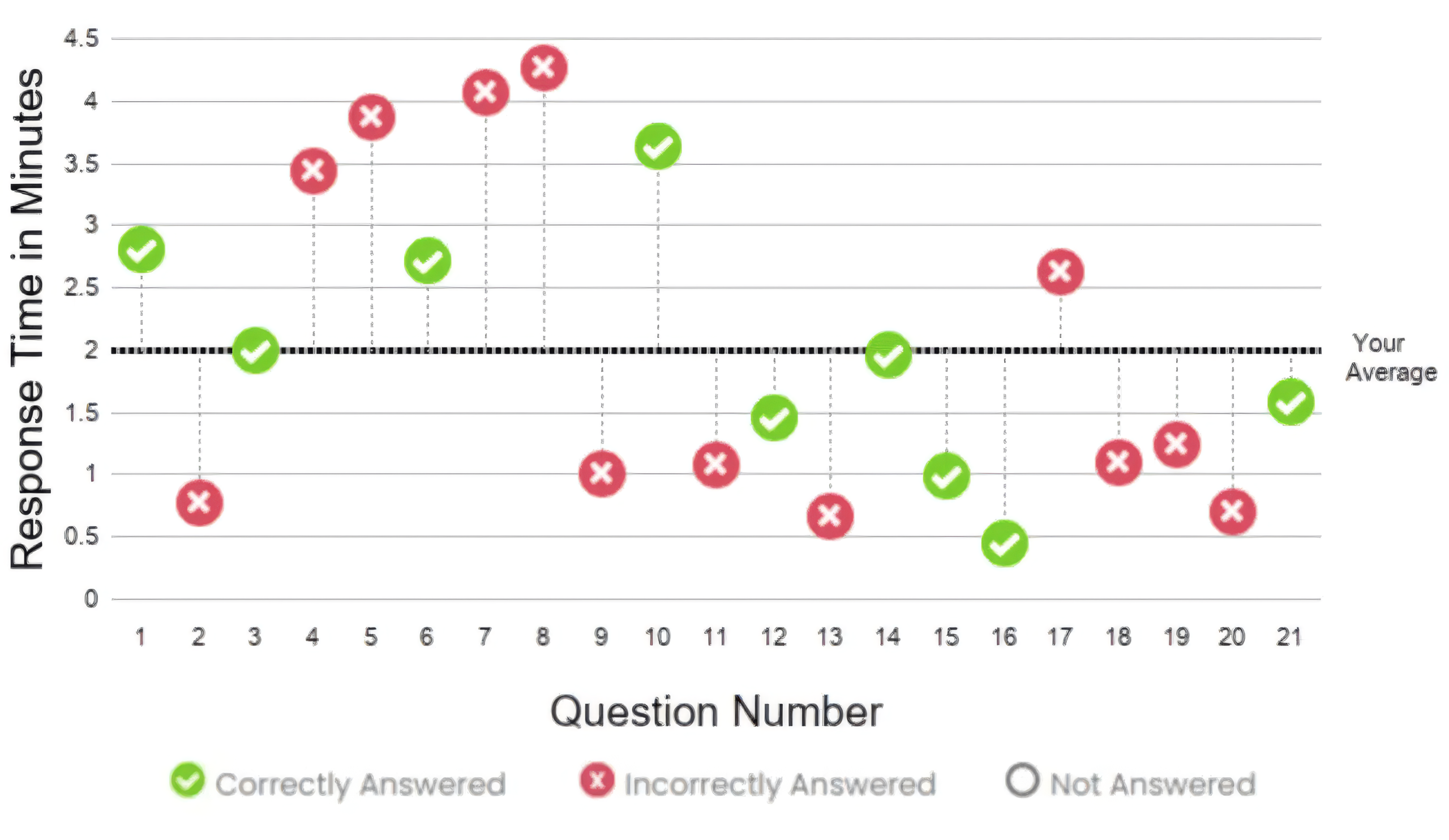
If you see this pattern, it may be a sign that you’d benefit from doing a few warm-up problems before your next attempt. It can also be a telltale sign of test-day nerves. If you suspect anxiety played a role, our Beginner’s Guide to Test Anxiety is a good place to start, along with our test-anxiety video series and test-anxiety quiz.
Some test-takers instead miss a disproportionate number of questions toward the end of a section. That can also be caused by anxiety, since the pressure often builds as the clock winds down, but it can just as easily reflect a stamina issue. In that case, studying in a way that builds endurance, or experimenting with a different section order, could help.
If you see this pattern on your score report, consider taking our free test anxiety quiz to identify what might be affecting you on test day.
Take the QuizInconsistent Timing
The same Question Performance and Time Management section also shows whether you paced yourself well throughout the section. If your average time per question gets shorter as you progress, it’s a sign that you probably spent too much time on earlier questions.
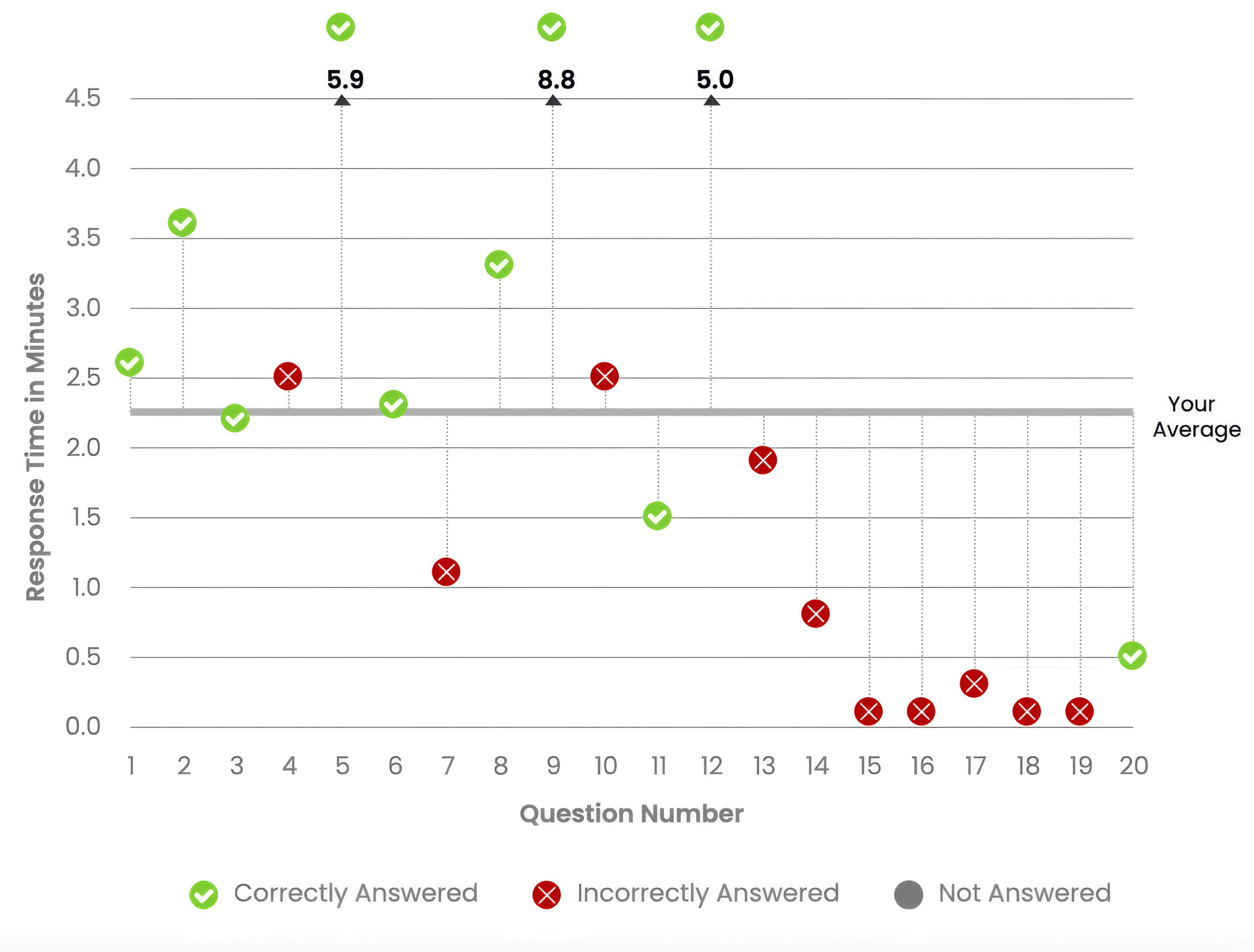
That tradeoff simply isn’t worth it. No single question is worth spending that much of your time on. If you see this pattern on your score report, one of the most valuable skills you can develop is learning to let go of questions that are giving you trouble.
For more on this, check out this video on how to manage your time on the GMAT.
Omitting Questions
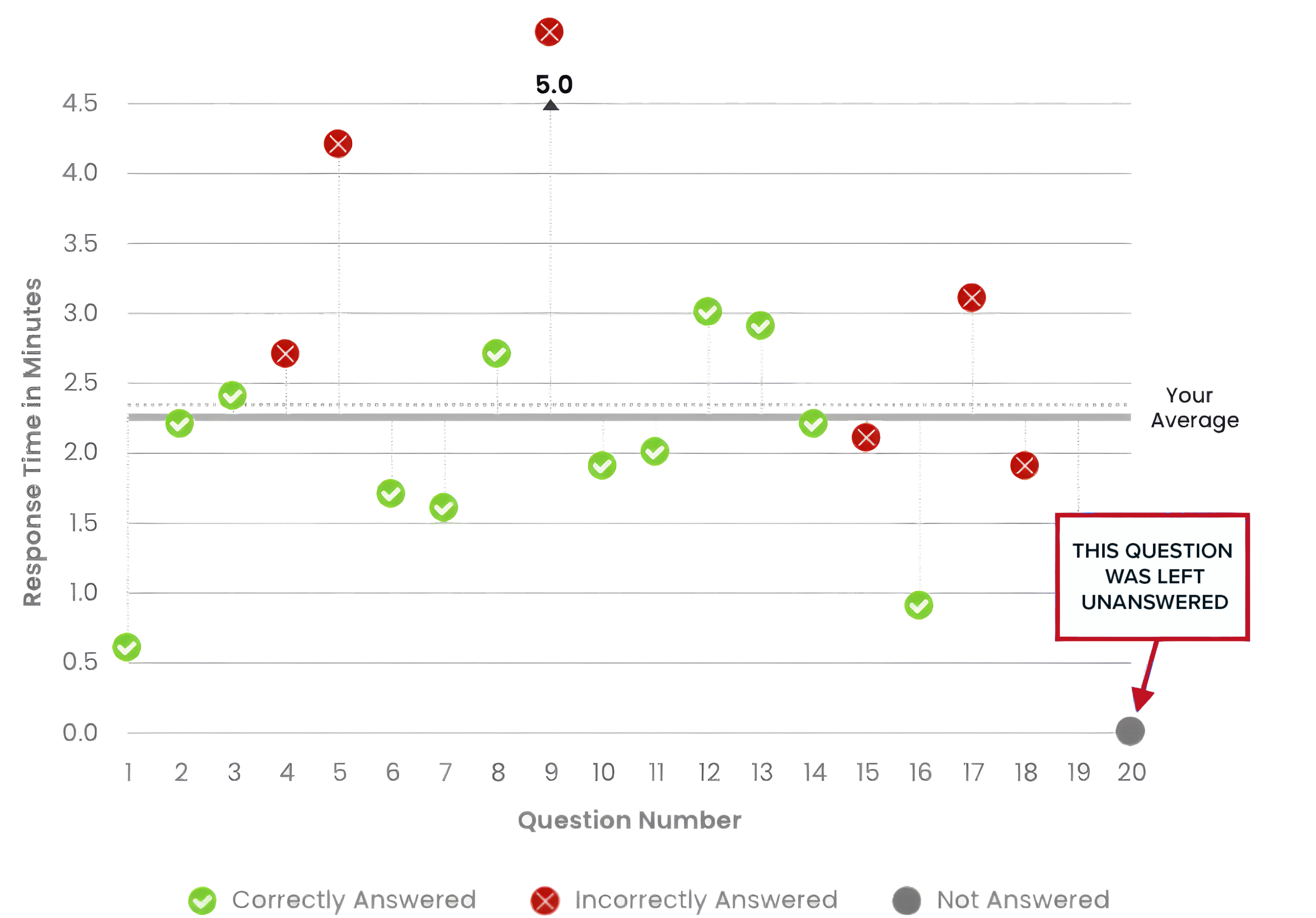
The current GMAT penalizes unanswered questions heavily. If you see omitted questions on your score report, make sure you answer every question on your next attempt, even if you have to guess at the end. An incorrect answer typically costs you far less than leaving a question unanswered.
Time Spent on Questions You Answered Incorrectly
Next, look at the time you spent on questions you ultimately answered incorrectly. If you spent far too long on a question you missed anyway, that’s a sign you got stubborn when your time would have been better spent elsewhere. The fix is to practice letting go of difficult questions as soon as you realize you don’t have a clear path to the solution, rather than chasing one you’re unlikely to find.
If you answered a question incorrectly very quickly, there are two possible explanations. Maybe you recognized that the question was too difficult and moved on early—in which case, great. Or maybe you rushed through an easier question and made a careless mistake, in which case you should practice slowing down and checking your work on questions you know you can solve. This video will help you learn how to avoid careless mistakes on GMAT Quant.
If you had timing issues, you probably already suspected as much. Your score report won’t tell you anything entirely new, but it will confirm the problem and help pinpoint where things started to go wrong.
Performance by Question Type
Another thing to check is whether you struggle with particular question types.
It’s remarkably easy to overreact to this data. If your percentile rankings differ only slightly across question types, you can probably ignore it, because each category is based on only a handful of questions. But a genuinely large gap, such as a significant difference between your Critical Reasoning and Reading Comprehension performance, can help guide your studies.
Question Review and Edit Summary
This section tells you how much time you spent reviewing questions, how many answers you changed, and what effect those changes had. You’re mainly looking for unusual patterns.
Did you spend a lot of time reviewing? That time might have been better spent answering more carefully on your first pass. Did you change answers from correct to incorrect? That can be a sign that second-guessing is hurting more than it’s helping.
How the Score Report Is Not Useful
Your score report can reveal valuable insights, but it can’t tell you everything. For starters, it doesn’t show you the actual GMAT questions. Sorry to be the bearer of bad news.
The Performance by Fundamental Skills section is especially questionable. The sample sizes are so small that any conclusions should be treated cautiously. Quantitative Reasoning questions, for instance, are split across four “fundamental skills” categories, so each category may be based on as few as three or four questions. Take the results with a grain of salt, and don’t overreact to modest differences.
The report also offers little guidance on what those skills actually mean. For example, it lists “Analysis/Critique” as one of four Critical Reasoning skills, yet nearly every Critical Reasoning question requires analysis. It’s difficult to know exactly what GMAC means by the label or what you’re supposed to do with that information.
Finally, while the report can hint at the kinds of questions you missed, it rarely tells you why you missed them. It might show that you had a poor start in Quantitative Reasoning, but unless you remember what was happening at the time, the cause could have been stubbornness, anxiety, or simply a mind that was still stuck on the previous section.
If your score report points to weaknesses you want to improve, How to Overcome a Low GMAT Score is the natural next step.
Frequently Asked Questions
What is a GMAT score report?
It’s the official record of your GMAT performance. It includes your total score, section scores, and percentile rankings. This is the information business schools receive. The detailed performance breakdown goes further, showing per-question results, timing data, and question-type performance. Only you can access that detailed breakdown.
How long does the GMAT score report take?
You’ll see your unofficial scores immediately after finishing the exam. Your official score report typically appears in your mba.com account within a few business days, although it can occasionally take longer.
Does the GMAT penalize unanswered questions?
Yes. The current GMAT penalizes unanswered questions, so it’s always better to submit a guess than to leave a question blank.
What’s the most useful part of the GMAT score report?
The Question Performance and Time Management data. It reveals bad starts and finishes, pacing problems, and how long you spent on questions you missed, which is where most fixable issues show up. The Performance by Fundamental Skills data is the least reliable, because it relies on small samples of data.