Free Online GMAT Course
At GMAT Ninja, we’re passionate about helping students reduce the stress and pain of studying for admissions exams – regardless of their ability to pay for tutoring or a test prep program. This free course has helped tens of thousands of MBA applicants improve their scores, and it represents our honest effort to provide everything you need for the GMAT.
Before we start…
A quick note about this free course: the lessons uphold our teaching quality, start to finish. It’s as thorough of an experience as we could create, with a handful of YouTube videos and a simple webpage as our medium.
What this free course can’t give you is a structured way to practice what you learn.
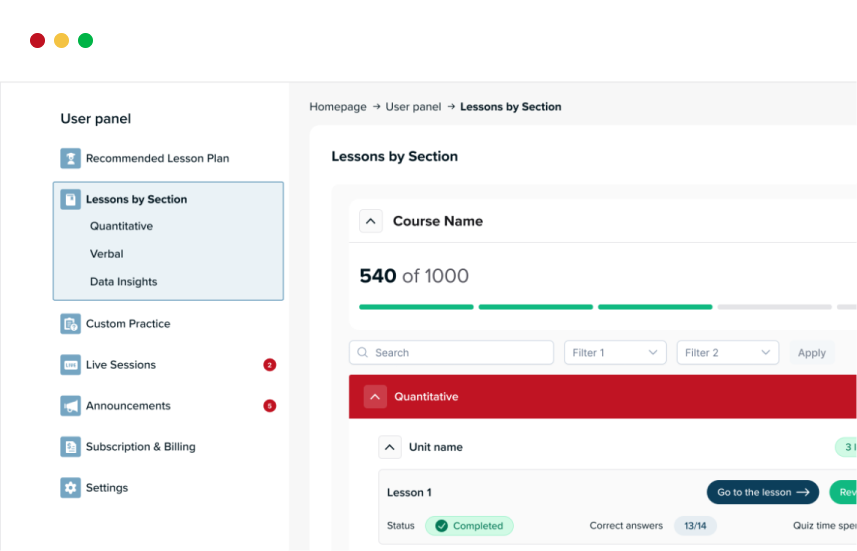
For that, we created the GMAT Ninja Course, now in Quant early access. Check it out — the first few lessons are free.
- 70+ video lessons
- 3,000+ practice questions
- Weekly live classes with our team of expert tutors.
- Try the first lessons free, no credit card required.


The Basics
Welcome to the world’s best 100% free GMAT prep course!
Before we get started, watch this video:
If you’re taking the Graduate Management Admission Test (GMAT), odds are good that you’re pursuing a business-focused graduate programs such as an MBA, MiM, and MFin programs, among others. To evaluate your skills for entry into those programs, the GMAT assesses a mix of quantitative, reading, reasoning, and data analytics skills.
For many test-takers, the biggest challenge of the GMAT is that it doesn’t simply assess how much “stuff” you know. More than anything, it tests your ability to think flexibly, maintain mental clarity under pressure, and make decisions amid time limitations and other constraints.
Many students struggle on the GMAT not because they’re fundamentally bad at reading or math, but because they misunderstand how the test works, rely on inefficient study habits, or make avoidable mistakes in timing, planning, or execution. Those issues quietly limit students’ scores long before content knowledge becomes an obstacle.
The resources in this section focus on the big-picture mechanics of the GMAT: how the exam is structured, how scoring actually works, and how to study effectively.
Let’s first establish your starting point by asking: “What is your big picture GMAT problem?”.
We find students fall into a few major categories when faced with this question. Click the options below that apply to you to learn more.
Choose Your Big Picture Problem.
I’m not sure how the GMAT actually works.
If this sounds like you, the issue usually isn’t ability; it’s uncertainty. When the test feels opaque, it’s hard to study efficiently or trust your decisions on test day.
The GMAT is adaptive, heavily standardized, and designed to reward specific behaviors. Many students lose points — or waste valuable study time — simply because they misunderstand how sections are scored, how questions adapt, or what schools actually see on a score report.
If this is what’s holding you back, start here: What is the GMAT? A Complete Guide.
I don’t know how to structure my GMAT prep.
If this sounds like you, the problem may not be effort — instead, it may be direction. Studying without a framework often leads to spinning your wheels or over-focusing on the wrong things.
Strong GMAT prep is about sequencing: knowing when to learn, when to practice, when to review, and when to stop. Many self-studying students stall because they treat all activities as equally valuable.
If this is what’s holding you back, start by watching this video on how to start studying for the GMAT.
In this video, Charles outlines a clear and efficient way to start your GMAT studies the right way. You’ll learn when to take your first official practice test; how to interpret your results and set the right GMAT score target; how choose between self-study, courses, or tutoring; and avoid burnout and test anxiety.After you’ve watched the video, visit our complete guide on How to Study for the GMAT, which has all the information you need to start your prep.
Make sure to check out our full self-paced course and our tutoring services if you’re looking to pursue either for your studies.
I’m stuck, and my score isn’t improving.
If this sounds like you, the issue is rarely that you’ve “hit your ceiling.” More often, it’s that your study loop isn’t generating useful feedback.
Many students keep doing more of what already isn’t working: more questions, more notes, more hours, but they never change their underlying process. If you’re mindlessly “getting reps”, you’re very unlikely to improve on a reasoning-based test like the GMAT.
If this is what’s holding you back, start here:
- How to Overcome a Low GMAT Score: What low scores usually mean — and how to respond productively.
- How to NOT Get Stuck When Studying for the GMAT: How to diagnose plateaus and make targeted changes.
I’m unsure what prep option makes sense for me.
If this sounds like you, the problem isn’t indecision. Instead, it’s a lack of clarity about tradeoffs. Courses, tutoring, and self-study all work in the right context.
Many students choose prep options based on price or promises instead of fit, timeline, and learning style and end up frustrated.
If this is what’s holding you back, start by reading this guide on how to choose between a course, tutoring, and self study, which gives you a practical comparison on what each option is actually good for.
We have options available for no matter what type of prep option you choose.
- Our free course (that’s where you are now!)
- Our self-paced course
- Our one-on-one tutoring services
I know the material, but anxiety wrecks my performance on test day.
If this sounds familiar, the issue usually isn’t preparation or ability, it’s about maintaining control under pressure.
Many strong test-takers perform well in practice but underperform on the real exam, because anxiety alters how they read, reason, and manage time. Even if you don’t have classic signs of nervousness, test anxiety can narrow your attention, speed up decision-making in the wrong ways, and make otherwise familiar questions feel painfully foreign.
If you care about your GMAT score, you’ll inevitably feel some pressure on test day. Learning to manage your internal response to pressure — both before and during the test — is a skill in its own right, and it’s one that can be trained deliberately.
If this is what’s holding you back, start by reading our Guide to Test Anxiety. It provides a practical overview of why test anxiety happens, how it affects performance, and what actually helps — before, during, and after test day.
You might find these videos helpful too:
If you’ve made it this far, you can hopefully identify some of the big-picture problems we described at the start — and maybe you’ve recognized one or two of your own. That’s the foundation we’re going to build off of.
We’ve divided this course up by section to help you navigate it. Click below for the section you’d like to study from. If you’re new to the GMAT, we suggest starting with the Quant section.
Select your section.


Need a more thorough approach to the GMAT? We’ve got you.
Our free GMAT course is thorough, but for most students, you’ll need more than this to get to your target score.
Luckily, we made that too. Currently available in early access, covering the entire Quant section.
- Nearly 70 lessons spanning the entirety of GMAT Quant
- Practice quizzes for each topic
- Question bank with 5,000+ tutor-vetted questions
- Weekly live classes with our tutors