Free GMAT Reading Comprehension Course
Building the skills for reading long passages under time pressure.
GMAT Reading Comprehension assesses your ability to read carefully, reason precisely, and stay anchored in what the passage actually says. While RC can feel overwhelming under time pressure, especially when passages are dense or unfamiliar, the skills being tested are highly specific and learnable.
The GMAT doesn’t reward speed-reading, prior knowledge, or test-prep “tricks”. It rewards disciplined, systematic reading and clear thinking under pressure. Many test-takers struggle in RC not because they can’t understand the passages, but because small process errors compound over time: reading a bit too fast, paraphrasing loosely, overreacting to familiar-sounding language, or spending too long trying to rescue a single question.
Our free GMAT Reading Comprehension course is designed to help you develop a reliable, consistent RC process, one that improves accuracy and timing by focusing on how passages are written, how questions are constructed, and how, exactly, wrong answer choices can mislead you.
How to Read GMAT Reading Comprehension Passages
Watch the video below before diving into the sections that follow. It explains how GMAT Reading Comprehension actually works, what the test does (and does not) reward, and why many common RC instincts quietly backfire. With that framework in place, the explanations in the accordions below will be much easier to apply.
GMAT Reading Comprehension Lessons
Test-takers don’t usually struggle on Reading Comprehension because passages are “too hard.” Test-takers struggle because they don’t know what to look for, what to ignore, or why each part of the passage is there.rnrnThis series is built to fix that. Each video trains you to read for structure and purpose: how the author builds each argument, how each paragraph fits into that argument, and how GMAT and EA questions exploit common reading habits under time pressure.



Common RC Pitfalls
I read the passage, but I don’t really absorb it.
If RC passages feel like they go in one eye and out the other, the problem usually isn’t vocabulary or intelligence. It’s how you’re reading.
Many test-takers try to improve efficiency by forcing themselves to read faster. On GMAT Reading Comprehension, that almost always backfires. When you skim or rush, you miss structure, author intent, and nuance — which means the questions end up taking longer and your accuracy drops.
Strong RC performance comes from engaged, deliberate reading, not speed-reading. When you genuinely understand what the author is doing — arguing, evaluating, explaining, criticizing — the questions become much easier to answer, and paradoxically, you often finish faster.
If this sounds familiar, start here: Don’t Read Too Fast on GMAT Verbal. This short explains why trying to maximize speed hurts both accuracy and timing — and what “efficient” reading actually looks like on GMAT RC.
If you want a broader framework for how to approach RC passages from the ground up: Beginner’s Guide to GMAT Reading Comprehension. A clear overview of how GMAT RC is designed, what it’s really testing, and how strong readers approach passages differently from struggling test-takers.
I keep missing Primary Purpose/Main Idea questions.
If you’re consistently missing Primary Purpose questions, it’s usually not because you didn’t understand the passage — it’s often because you’re answering a different question than the one being asked.
Many RC answers contain true statements about the passage that aren’t the author’s main point. GMAT Primary Purpose questions don’t ask what the passage talks about (the topic); they ask why the author wrote it — to argue, evaluate, criticize, explain, compare, or challenge something.
Two other habits make this worse:
- Assuming that the main idea must appear in the first or last paragraph
- Gravitating toward answers that feel familiar or detailed, rather than big-picture
Strong RC readers keep asking a single question as they read: “What is the author doing here, and why?”
If this sounds like your issue, start here: Why You’re Missing Primary Purpose Questions. This video breaks down the most common mistakes test-takers make on Primary Purpose questions — and how to reliably separate topic from intent.
If you want to go deeper into why RC feels slippery or “subjective” on these questions: Is GMAT Verbal Arbitrary and Subjective? Why RC questions feel debatable and why, in reality, there’s almost always only one answer that fully matches the author’s intent.
I try to read faster, but my accuracy gets worse.
This is one of the most counterintuitive lessons in GMAT Reading Comprehension:
Reading faster usually makes you slower.
Many test-takers try to boost efficiency by skimming aggressively, pushing their eyes through the passage, and hoping to “figure it out” from the questions. The problem is that this almost always backfires. When you don’t fully absorb the passage, the questions take longer, feel more confusing, and lead to more second-guessing.
Strong RC performance doesn’t come from speed-reading.
It comes from engaged reading — understanding structure, tracking the author’s intent, and noticing how ideas relate to one another.
If you’re prepared when you reach the questions, they often go quickly and cleanly. If you’re not, every answer choice feels plausible, and your timing can spiral.
If reading speed feels like your main bottleneck, start here: Don’t Read Too Fast. Why forcing speed hurts both accuracy and timing — and what to do instead if you want RC to feel calmer and more controlled.
There’s also a deeper pitfall hiding behind “fast reading”: Paraphrasing Will Destroy Your Verbal Performance. Why rewording passages in your own language introduces distortions, and how sticking closely to the author’s exact wording improves both accuracy and efficiency.
Related reading: Anatomy of a 9-Minute GMAT RC Question. A real example of how misunderstanding a passage early can turn one question into a timing disaster — and how to prevent it.
The answer choices trick me because they reuse words from the passage.
If RC answer choices often feel tempting because they repeat language from the passage, you’re running into one of the most common GMAT verbal pitfalls: word matching.
Wrong answers frequently lift words or phrases directly from the text to sound familiar and safe. At the same time, correct answers often restate ideas using different language. If you rely too heavily on matching words instead of matching meaning, you’ll consistently eliminate the right answer and keep the wrong ones.
Strong RC performance comes from engaging with what the answer choice really means, not how closely it mirrors the passage’s wording. The key question isn’t “Does this sound like the passage?” It’s “Does this actually answer the question being asked, based on the passage’s meaning?”
This is especially important when answer choices are dense or abstract. In these situations, surface-level familiarity is a very unreliable guide.
If this sounds like your experience, start here: Beware of Word Matching. This video explains why repeated wording is such a powerful distraction on GMAT RC — and how to train yourself to focus on meaning instead of familiar language.
If you find that answer choices feel debatable or subjective when this happens: Is GMAT Verbal Arbitrary and Subjective? Why verbal questions feel arguable when you focus on surface similarities — and how thinking precisely and systematically about meaning helps the correct answer stand out more clearly.
RC timing is killing me! I’ll get stuck on one question and spiral.
If your Reading Comprehension timing keeps blowing up, it might not be because you’re slow in general — it’s often because one question derails the entire passage.
Many students see an RC question that feels ambiguous or uncomfortable, and they respond by digging in harder: rereading lines, second-guessing interpretations, and trying to force certainty. Before they realize it, several minutes have passed, anxiety has spiked, and the remaining questions feel rushed and shaky.
The GMAT is designed to punish this kind of perfectionism. RC questions rarely reward exhaustive analysis. Strong test-takers make deliberate decisions about when to keep pushing and when to let go, even if that means moving on without full confidence.
Good RC time management isn’t about rushing — it’s about avoiding sunk-cost spirals.
If this sounds familiar, start here: Anatomy of a 9-Minute GMAT RC Question. A real case study showing how one RC question turned into a timing disaster on an actual exam — and the exact decision points when things went off the rails.
If you tend to get stuck because no answer feels “good enough”: Don’t Be a Perfectionist on GMAT Verbal. Why RC answers don’t need to feel perfect — and how insisting on certainty often costs more points than it saves.
If your spiral starts when you react too quickly and then overcorrect: Don’t Just REACT… Stop and THINK. How impulsive eliminations and emotional reactions create timing problems — and how a calmer evaluation process keeps RC under control.
Select your section.



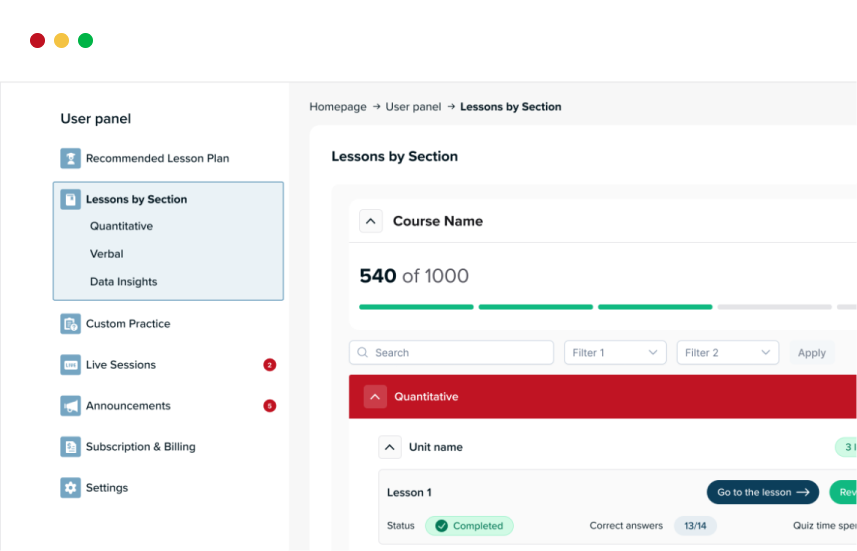
Need a more thorough approach to the GMAT? We’ve got you.
Our free GMAT course is thorough, but for most students, you’ll need more than this to get to your target score.
Luckily, we made that too. Currently available in early access, covering the entire Quant section.
- Nearly 70 lessons spanning the entirety of GMAT Quant
- Practice quizzes for each topic
- Question bank with 5,000+ tutor-vetted questions
- Weekly live classes with our tutors