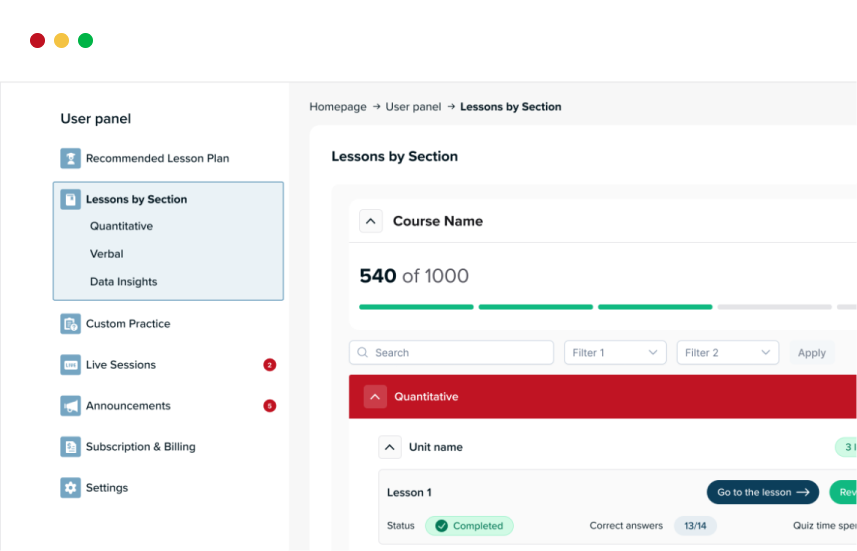
Free GMAT Data Insights Course
Make sense of messy information, reach sound conclusions.
The Data Insights (DI) section consists of 20 questions, with a mix of five question types: Data Sufficiency, Graphical Interpretation, Table Analysis, Multi-Source Reasoning, and Two-Part Analysis. Like the previous sections, DI combines with quant and verbal to form your composite score on a scale of 205 to 805.
Data Insights tests your ability to make sense of messy information and reach sound conclusions under time pressure. It blends quantitative reasoning, verbal reasoning, data analysis, and logic, but in a format that often looks far more intimidating than it actually is.
What Data Insights doesn’t reward is grinding through every calculation, decoding every graph in excessive detail, or overreacting to information overload. Many strong test-takers lose points on DI by over-calculating, over-reading, or panicking when the information feels dense, “weird”, or unfamiliar.
Our free GMAT Data Insights course focuses on building a calm, structured approach to DI questions: one that emphasizes judgment, estimation, and strategic decision-making so you can identify what matters, ignore what doesn’t, and protect both accuracy and timing.
Data Insights Lessons
Test-takers rarely struggle on Data Insights because the math is hard, or because they don’t know how to read a graph or chart. Test-takers struggle because they get overwhelmed by information, chase irrelevant details, or spend too long trying to calculate everything perfectly.
This free video course is designed to fix that. Each video focuses on how to interpret data efficiently under time pressure by understanding what matters, what doesn’t, and how GMAT and EA questions quietly push you toward time-wasting spirals.

Common Data Insights Pitfalls
Data Insights feels overwhelming! There’s just too much information.
If this sounds familiar, the problem usually isn’t your math skills or your reasoning. It’s the intimidation factor. Data Insights questions are deliberately information-dense, and many test-takers feel overwhelmed before they even read the question carefully.
When that happens, test-takers often rush through the graph, sloppily skim the text, or start calculating without a clear plan — which leads to mistakes or time blow-ups. In reality, DI questions often ask something simpler than you might expect.
If this sounds familiar, start here: Don’t Get Intimidated by Data Insights. This video explains why DI questions often “look scarier than they are,” and how slowing down at the right moment actually improves both accuracy and timing.
These DI graphs are terrible! Who would design something like this?
You’re not wrong. Many GMAT Data Insights graphs are genuinely awkward, cluttered, or unintuitive. But that’s not an accident — it’s part of what the test is measuring.
The GMAT isn’t testing whether you like the graph. It’s testing whether you can extract relevant information from a poorly presented data source without getting distracted by noise.
If this sounds like your issue, start here: Sometimes GMAT DI Graphs Are Terrible. This explains why the GMAT uses messy graphs, and how to stop fighting the format and start working with it.
I waste too much time crunching ugly numbers.
On Data Insights, calculation is often the slowest — and least important — part of the problem. Many DI questions can be answered through smart estimation, visual comparison, or elimination before doing any precise math.
The key skill is knowing when estimation is safe, and when the answer choices are too close together to allow it. (It also helps to remember that you have a calculator for DI when you really need it.)
If this feels like your main bottleneck, start here: Data Insights: When Should I Estimate? This video walks through when estimation saves time, and how to avoid the situations when it backfires.
I keep running out of time on Data Insights.
Timing problems in DI usually aren’t caused by one slow question — they’re caused by trying to treat every question equally. Some questions are worth grinding through. Others are not.
In particular, Multi-Source Reasoning sets can quietly consume huge chunks of time if you’re not careful.
If this sounds like your experience, start here: Skip an Entire Multi-Source Reasoning Set? This explains when skipping (or semi-guessing) a full MSR set might actually be the correct strategic decision — and when it isn’t.
I keep making mistakes on Data Sufficiency, especially with the second statement.
Data Sufficiency errors often come from mental carryover. Test-takers accidentally reuse information from Statement 1 when evaluating Statement 2, or rush straight to combining the statements without fully testing them individually.
Strong DI performance requires disciplined mental resets between statements.
If this sounds familiar, start here: Don’t Forget to Wash Your Brain on Data Sufficiency. This video introduces a simple habit that dramatically reduces careless DS errors.
Select your section.




Need a more thorough approach to the GMAT? We’ve got you.
Our free GMAT course is thorough, but for most students, you’ll need more than this to get to your target score.
Luckily, we made that too. Currently available in early access, covering the entire Quant section.
- Nearly 70 lessons spanning the entirety of GMAT Quant
- Practice quizzes for each topic
- Question bank with 5,000+ tutor-vetted questions
- Weekly live classes with our tutors