

How to Choose Between a GMAT Course, Tutor, and Self-Study

Should you study on your own, take a GMAT course, or hire a tutor? There’s no one-size-fits-all answer, but in this article, we’ll break down the pros and cons of each option and help you make the best decision for your situation.
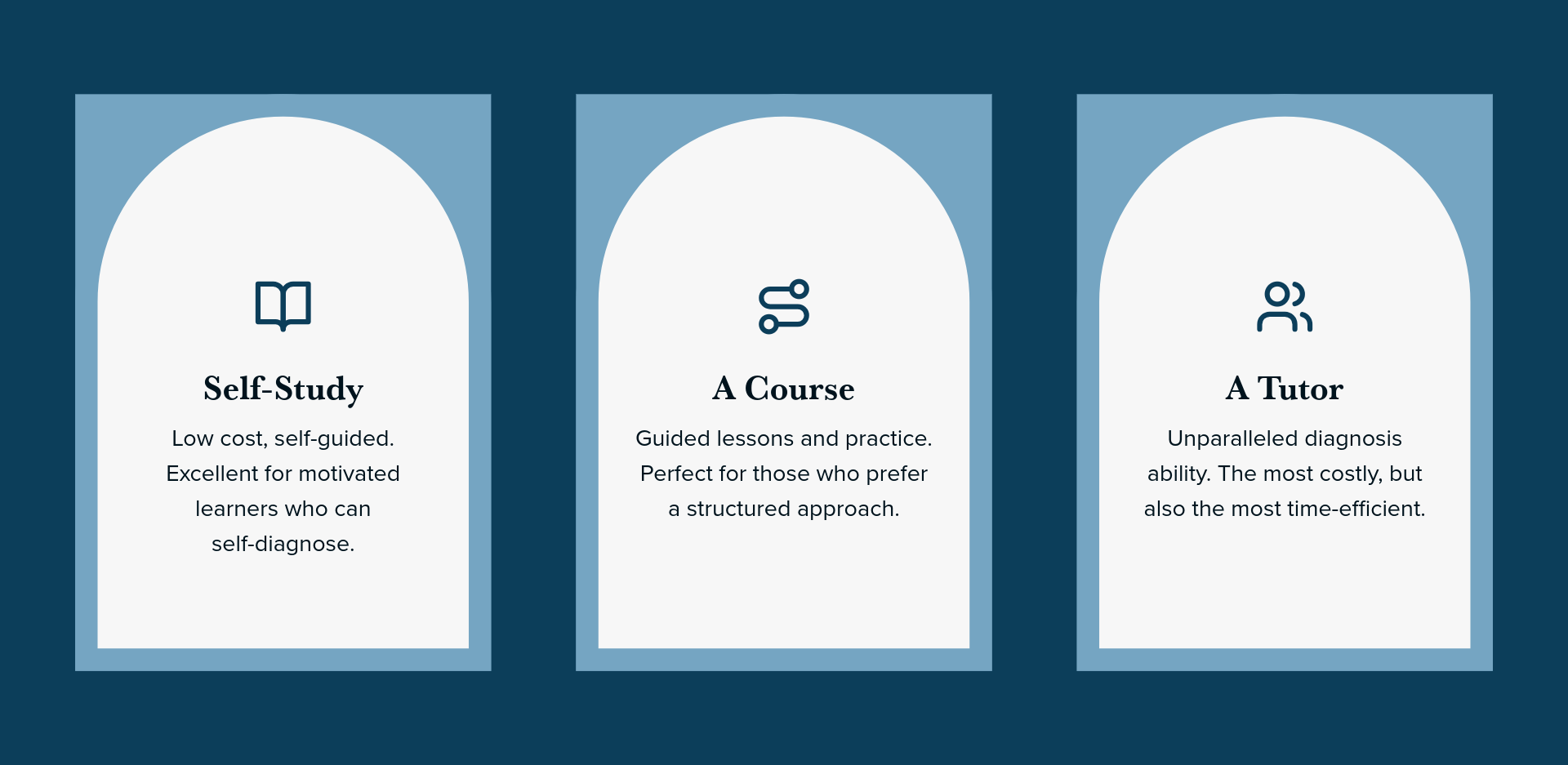
If You Have Time, Start With GMAT Self-Study
The advantages of studying on your own are obvious. You’ll save a ton of money by using inexpensive, off-the-shelf materials, such as the GMAT Official Guides, mba.com practice tests, free study plans, or [LINK: Free GMAT Video Course]. Self-study is also flexible, allowing you to get a feel for the GMAT on your own terms.
When GMAT Self-Study Goes Wrong
Unfortunately, there are three major limitations to a self-study program:
- You’ll need to be great at self-diagnosis and problem-solving, since you’ll address your weaknesses on your own.
- It can be overwhelming to figure out where to begin and how to spend your study time.
- Self-study demands considerable self-discipline to maintain a study plan over time.
If you’re introspective and self-motivated, you’ll probably have a wonderful experience studying on your own. But if you’re like many GMAT students, you might struggle to understand Why Is My GMAT Score Not Improving?, or how best to invest your study time.
As soon as you realize that your self-study efforts aren’t paying dividends, we recommend investing in a course or tutoring immediately. If you’re struggling to put in enough homework hours, the structure of a course, or the nagging of a tutor, might be exactly what you need. If you can’t figure out why you aren’t improving, or have no idea where to start, some sort of expert help is certainly worth the investment.
Of course, if you just need a bit of fine-tuning, or if your self-study efforts are clearly paying off, there’s absolutely no good reason to hand your wallet over to a test-prep company.
If You Need Structure on a Budget, Start With a GMAT Course
If you want to avoid the overwhelming task of creating your own GMAT study plan, a GMAT course might be the perfect fit.
Thanks in part to the wonders of the internet, GMAT courses come in a wide variety of formats. At one end of the spectrum are on-demand courses [LINK: GMAT Ninja course], which usher you through online GMAT lessons at your own pace. Other online courses feature live instruction, and if you’re supremely old-school, you could even attend lessons in a physical classroom.
A course’s real job is to hand you a curriculum and a sequence so you’re not deciding what to study, and in what order, on your own. That’s the biggest value: structure, for far less than the cost of one-on-one help. It’s also the honest limit of what a course can do.
Courses teach the same material to everyone, which means they offer limited individual feedback, and they may not help students who struggle with subtler issues such as bad test-taking habits, imprecise reading skills, or test anxiety. If your score is stuck for a reason you can’t name, a course usually won’t catch it, and in some cases the extra volume just reinforces the habits that are holding you back.
But if you need some structured guidance, particularly on quant topics, GMAT courses can be a budget-friendly way to move your studies forward. We have more to say about the value of courses in: Are GMAT Prep Courses Worth It? and if you’re comparing your options, [LINK: Best GMAT Prep Course] here’s how we’d judge what makes a course truly effective.
Need to Save Time? Invest in GMAT Tutoring
One-on-one GMAT tutoring usually isn’t cheap, and if you’re like most people, you might hesitate to make that investment. Most test-takers who hire a tutor do so as a last resort, after they’ve failed to achieve their target score through self-study or an inexpensive course.
Why might you want to hire a tutor at the very beginning of your studies? The biggest reason is to save time.
Because a tutor provides one-on-one guidance tailored to your unique needs, it’s typically the most efficient way to prepare. A skilled tutor will aggressively target your most consequential weaknesses, in addition to handling tasks such as choosing practice materials and analyzing your results. That allows you to focus exclusively on improving your GMAT skills, and when the process is managed properly, every minute of your studies is maximized.
That’s the real math behind tutoring prices, which run from $20 an hour to several hundred: you’re buying two scarce things, diagnosis and time, so the honest cost comparison isn’t tutor vs. course. It’s tutor vs. months of your own trial and error.
Just don’t read the price tag as a quality signal in either direction: we’ve met spectacular teachers who undercharge and horrendous ones who charge a fortune. Also, be ready for realistic expectations wherever you go: the average GMAT retaker improves by about 30 points, and anyone promising you ten times that in a few weeks is selling something false.
If tutoring goes well, you’ll save an enormous amount of time. Of course, that time savings comes at a higher financial price than courses or self-study. For what separates a great tutor from the rest, see: How to Find a Good Private GMAT Tutor (the short version: six checks, starting with “hire a GMAT specialist, not a math generalist”). Still weighing the investment itself? We break that down in: Is a GMAT Tutor Worth It?
One more thing worth knowing before you hire anyone, including us: good tutoring is not a comfortable spa treatment. Ours comes with 15 hours of homework a week, lots of data tracking, and a promise to tell you the truth about how far you are from your goal. If that sounds intense, we wrote a whole article about why you might hate working with us. If you’re not scared away by that article, we’ll get along wonderfully.
“Help, I Don’t Know Why I’m Struggling With the GMAT!”
If your scores are flatlining and you don’t know why, we strongly recommend seeking tutoring help ASAP, regardless of where you are in your studies. We frequently meet students who develop terrible test-taking habits without realizing it, and until a coach helps you identify and change those habits, studying might do more harm than good, since it might just reinforce those bad habits.
So if you’re struggling to diagnose your own GMAT issues, please invest in some sort of support sooner rather than later, regardless of your score goals or timeline.
The Decision, Distilled
Notice that the three options fail in symmetrical ways, and that symmetry is what makes up the core of this decision.
A course is the wrong tool when your problem is an inability to diagnose your weaknesses, because a course teaches the same material to everyone.
A tutor is the wrong tool when your problem is a lack of structure, because there’s no reason to pay one-on-one rates for a study plan you could get for far less.
And self-study is the wrong tool the moment you can no longer answer, honestly and specifically, the question, “Why did I miss that?”
So ask yourself which sentence sounds like you:
- “I know what to study, I just need to do the work.” Self-study, with official materials and our [LINK: Free GMAT Video Course].
- “I need a plan and a curriculum, built for me, that I can follow.” A course, and here’s [LINK: GMAT Prep Course] ours.
- “I’m stuck, I can’t explain why or I can’t afford the months it would take to find out.” A tutor, and here’s how ours works
One last note: whichever door you pick, it isn’t permanent. The most common successful path we see starts with self-study, adds structure when momentum stalls, and brings in diagnosis when the score stops moving.
Frequently Asked Questions
Should I get a GMAT course or a tutor?
They do different jobs. A course gives you structure and a curriculum for less than one-on-one help costs. A tutor diagnoses exactly what’s holding your score back and tailors everything to you. Pick the course if you just need a plan; pick the tutor if you need answers about why you’re stuck.
Is self-study enough to pass the GMAT?
For disciplined students who are good at diagnosing their own mistakes, yes. Official materials and free resources can carry you a long way. The moment your scores stall and you can’t explain why, that’s your signal to bring in help.
When should I switch from self-study to a course or tutor?
As soon as your efforts stop paying dividends. If you can’t keep up your homework hours, a course’s structure helps. If you can’t figure out why you aren’t improving, a tutor’s personalized diagnosis is the better investment.
How much does GMAT tutoring cost compared to a course?
Tutoring runs from $20 an hour to several hundred, while courses typically cost a fraction of a full tutoring engagement. The fair comparison isn’t the hourly price, though; it’s what you’re buying. Structure is cheap; diagnosis and saved months are not.