

How to Study for the GRE®
Studying for the GRE® isn’t like studying for an exam in college. Standardized tests like the GRE® are a different beast entirely, and to conquer them, your study plan requires one key ingredient: flexibility.
Here’s how to structure your prep the right way:
- Find out what score will get you into your target programs.
- Take an official practice test without too much studying to see how far away you are from your target score.
- Diagnose what went wrong. Then build a plan around closing that specific gap.
Read on for an in-depth guide on this very process. And if you’re looking for a more general overview of the GRE®, visit our guide here.
Step 1: Find Out What Score You Actually Need
Before you even begin your studies, look up the programs you’re applying to.
This sounds incredibly obvious, but we’ve met plenty of students who spent months chasing a score far above anything their target programs required, and a smaller number who studied hard toward a number that was never going to be enough. Both of these problems can be solved with twenty minutes of research.
Pull up three to five programs that interest you and find their published GRE® ranges or averages for admitted students. Then, be honest about the rest of your application. If your research background, work experience, or GPA is unusually strong, you might be fine with a score at or slightly below the median. If a key element of your profile is relatively weak, aim for a score that’s above the median for your target schools.
One thing to keep in mind: GRE® scores are reported separately for Verbal and Quantitative Reasoning, each on a scale from 130 to 170, and depending on what kind of program you’re applying to, admissions committees may weigh one score differently than another. For example, an engineering program will look hard at your quant score, but a literature program may barely glance at it. Find out which of the two numbers is most important for your target programs before you decide how to split your study time.
Step 2: Take a Cold Practice Test
Once you know your target, it’s time to find out where you’re starting from.
ETS gives you two free official practice tests, branded (with unnecessary capitalization) as POWERPREP Test 1 and Test 2. Note that POWERPREP Test 1 is untimed and unscored, so you may want to take POWERPREP Test 2 to give yourself the most accurate possible read on your starting point.
Official GRE® practice exams like these, found on the ETS website, are the only practice tests that give you a truly accurate measurement of your baseline, because they use the true scoring algorithm and real retired questions. Third-party practice tests are an approximation of that algorithm, and thus won’t give you a reliable baseline. In fact, you might be surprised how inaccurate some of the third party practice exam scores end up being (either for better or worse!).
Three rules for that first test:
- Don’t study too hard for it. A couple of hours spent learning the question formats is fine, since you don’t want to tank your score simply because you misunderstood how the questions work. But please don’t do more than that just yet: your studies will be much more efficient after you analyze the results of this first exam.
- Answer every question. Guess when you have to and keep moving.
- Simulate the real thing. The current GRE® runs just under two hours with no scheduled break, so don’t pause between sections, don’t check your phone, and definitely don’t pause during a question to look it up. To get an accurate read of your baseline, the exam needs to be taken under true conditions. Our guide to how long the GRE® takes covers the timing in further detail.
Once you have that practice test score, subtract it from your target. The distance between those two numbers is the gap your study plan needs to close. Understanding this target shapes the rest of your prep: how long you need to study, what you’ll focus on, and whether the timeline you originally had in mind is realistic.
Step 3: Set a Realistic Timeline
How long will it take you to hit your target score? That’s a great question to ask yourself. Unfortunately, there’s no universal answer. How long your prep takes will depend on the score differential you need to overcome, how quickly you pick up new material, and whether your weak spots are a quick fix or a slow grind.
Two more things to factor in. You can take the GRE® five times in a rolling twelve-month period, with 21 days between attempts, which is plenty of room for most people, though it can get tight if you’re planning multiple attempts around application deadlines. And if you’re applying in the fall, it’s worth starting earlier than you might think you need to. Prep that runs long tends to eat into the time you’d otherwise spend on your statement of purpose or application essays, and that’s a trade most applicants would rather not make.
Step 4: Build a Flexible Study Plan
Here’s the thing with rigid study plans: target dates to conquer a topic are mostly arbitrary.
Here’s an example to illustrate: let’s say at the beginning of my prep, I told myself I’d work on Reading Comprehension for two weeks, and then move onto the Quant section. As I study during those two weeks, it quickly becomes apparent that Reading Comprehension is a major weakness for me, and near the end of Week 2, I still need a lot more work. If I follow my rigid study plan that only blocked off two weeks for Reading Comprehension, I’ll need to move on, even though my Reading Comprehension skills are not strong enough for the exam. A flexible study plan acknowledges that weak area, and allows me to extend the time I spent on Reading Comprehension so I can continue improving.
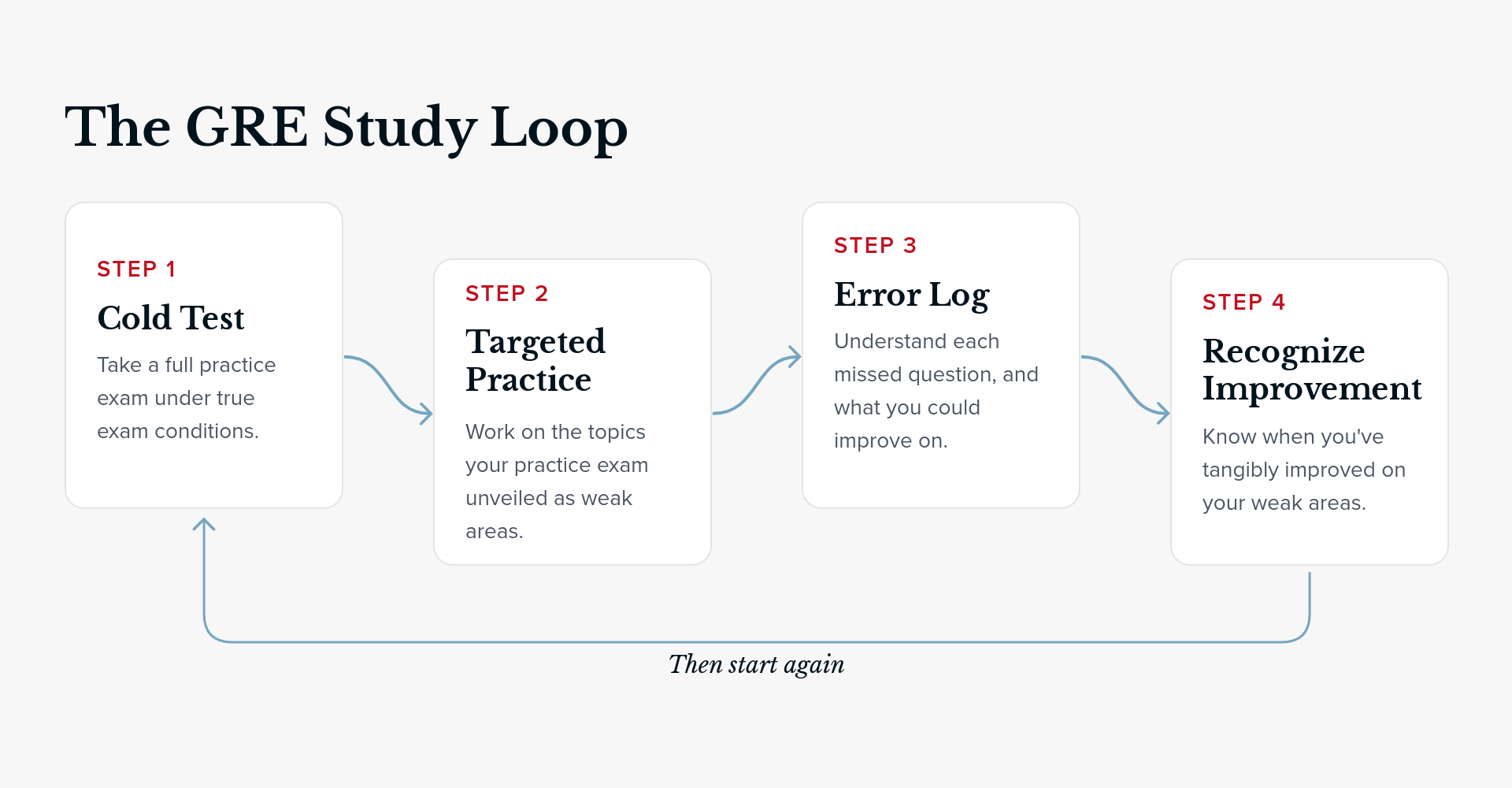
Instead of a fixed calendar, think of your prep as a loop:
- Study your weakest areas, ideally using official materials.
- Track the questions you miss in an error log.
- Look for the pattern in those misses, and implement fixes to avoid those mistakes in the future.
- Take a full practice test only when your homework data suggests you’ve improved.
- Repeat.
One nice benefit of this study loop is that it can effectively pick your test date for you. Instead of choosing an arbitrary date months in advance, you can schedule your exam once you hit your target score on a practice test. That way, you can go into the real thing with 100% confidence in your skills.
Lastly, a quick note about error logs: they only help if you’re honest, consistent, and precise. That means logging the questions you got right by luck alongside the ones you got wrong, and resisting the urge to label everything a careless error. “Careless error” often covers several different problems: misreading the question, rushing your setup, or skipping a step you tend to skip. Naming the specific mistake is what makes it fixable, and leads to legimate improvement.
Step 5: Decide What to Actually Study
With a target and a gap in hand, you can finally make some decisions about where your study hours go. Here are a few principles that hold for most students:
Use official material wherever possible. ETS questions behave differently from third-party ones, particularly on verbal, where the difference between a right and wrong answer can come down to a single word’s connotation. Third-party questions rarely capture that nuance, and practicing with them can teach you to read for the wrong signals.
On verbal, method matters more than memorization. About half of the verbal section is vocabulary-based, which sends most students straight toward flashcards. We’d suggest a different approach for most students, and we’ve written about why word lists tend not to help as much as you’d hope. What does work is the method in our guides to Text Completion and Sentence Equivalence, combined with daily reading that’s a bit harder than what you’d pick for fun.
On quant, the math is easier than the questions. GRE® quant covers arithmetic, algebra, geometry, and statistics, all at a high-school level, with no trigonometry or calculus anywhere. The difficulty tends to come from how the questions are constructed rather than from the math itself.
You can go light on the essay. The Analytical Writing section may come first on the exam, but for most programs, it matters the least. Most programs pay very little attention to this section, so learning the structure and writing a couple of practice essays is enough for most test-takers.
Don’t forget the skills that aren’t content. Timing, composure, and consistency are all trainable, and they account for more points than you’d think. Our guide to what the GRE® actually measures covers strategies for all three.
Use Your Practice Tests as Checkpoints
Official practice tests are a limited resource. In total, the ETS website provides two free practice exams (one of which is unscored and untimed), and three more you can pay for. For that reason, you’ll want to use them judiciously, and avoid burning through them too quickly. While you can technically retake them, that’s rarely a good idea, since repeating familiar questions can warp your timing and inflate your score.
So what does it mean to use the official practice tests judiciously? Bottom line, you want to treat them as checkpoints rather than as study material. Before you take one, ask yourself the following questions: has the work I’ve been doing addressed my weak areas? Does my error log show real improvement? Do I objectively expect myself to perform better than last time?
If the answer to these questions is yes, go ahead and take a practice exam. The results will give you precious data about your performance under test conditions, helping you structure the next cycle of studying to maximize your improvement.
One last note: even the most consistent students have good days and bad days, so expect some noise in this process. Any individual test can land a bit above or below your true level, so a surprising score in either direction is best treated as one data point rather than a final verdict.
What to Do If Your Score Stops Improving
Unfortunately, plateaus are common, and they’re usually a sign that something specific needs to change – not necessarily a sign that you simply need to work harder.
In our experience, plateaus are usually caused by one of three things: you’re practicing with the wrong material, you’re reviewing your errors too quickly to learn much from them, or you’re focusing on the wrong weaknesses.
For instance, maybe your plateau isn’t caused by holes in content knowledge, but by problems with timing, test anxiety, careless mistakes, or fatigue. These weaknesses are both far more common and far more damaging than most students expect. They can also be the hardest to spot, since they don’t always show up in an obvious way, even if you’re keeping a great error log. If you’ve been studying steadily and can’t figure out what’s holding your score back, you might benefit from some outside help. Figuring out what’s actually going wrong – even if it’s not at all what you would expect – is exactly what our tutors do best.
Frequently Asked Questions
How should I study for the GRE®?
Start by finding the score your target programs expect, take one official practice exam to measure how much you need to improve, then build a repeating loop of targeted practice, honest error review, and occasional full-length checkpoint tests, using official material throughout.
How long should I study for the GRE®?
It depends on the gap between your baseline and your target. Measuring that gap with a cold, initial practice test is the best way to start planning your testing timeline.
What’s the best GRE® study plan?
A flexible one. Rigid week-by-week calendars tend to break the first time you encounter a topic that you can’t master in the time you’ve allotted for yourself. A loop works better: study your weakest areas, log your errors honestly, and take a practice test only when your data suggests you’ve improved.
Can I study for the GRE® on my own?
Plenty of people do, particularly if they’re disciplined and reasonably good at diagnosing their own mistakes. Official materials and free resources will take you a long way. It’s worth investing in help when your score won’t move, and you’re not sure why.