

What Skills Does the GRE® Test Measure?
The GRE® measures your quantitative and verbal reasoning abilities, your ability to manage time, and your capacity to perform under pressure.
For more information about the GRE® as a whole, visit What is the GRE®?.
GRE® Quant Topics
The GRE® quant section is rooted in fundamental math concepts that are typically taught in high school.
Here are the most common topics:
- Arithmetic
- Algebra
- Geometry
- Exponents
- Percents
- Ratios
- Rates
- Probability
- Combinatorics
- Statistics
- Number Properties
Advanced math concepts such as trigonometry and calculus do not appear on the GRE® General Test.
GRE® Verbal Content
The GRE® Verbal Reasoning sections test two broad skillsets: reading comprehension and vocabulary.
GRE® Reading Comprehension (RC)
GRE® Reading Comprehension passages do not test subject-specific knowledge. Instead, they test your ability to read and comprehend written material, even when it covers an unfamiliar subject. On RC questions, test-takers are often required to:
- Identify the primary purpose or main idea
- Infer conclusions
- Discern logical structure
- Recognize style and tone
- Strengthen or weaken an argument
- Identify the role of different pieces within the argument
- Resolve an apparent paradox or discrepancy
To improve your accuracy and efficiency on these questions, please read our beginner’s guide to GRE® Reading Comprehension.
GRE® Vocabulary Questions
About half of the questions on the Verbal Reasoning section of the GRE® test your vocabulary. These questions require students to grasp the possible meanings of a sentence with omitted words, and to fill the blanks appropriately with the answer choices provided.
To learn more, check out our beginner’s guide to GRE® Text Completion and our beginner’s guide to GRE® Sentence Equivalence.
For a full overview of how the Verbal Reasoning section of the GRE® works, visit GRE® Verbal Explained.
The GRE® Analytical Writing Section
The GRE® Analytical Writing section consists of one 30-minute writing task.
The main skills tested on the Analytical Writing section are writing and logical reasoning ability, while grammar and mechanics are of secondary importance. The essay is written on a type of word processing software, but students will not have access to spelling or grammar checkers. (How much does this section matter? Usually, not much.)
Time Management on the GRE®
GRE® Quant Time Management
Let’s say that you’ve thoroughly studied the GRE® quant material, and you’re incredibly confident in your content knowledge. Then, on test day, a tough question pops up on the screen and you spend 10 minutes trying to solve it. Suddenly, you’re out of time, and you didn’t even have a chance to look at the last five questions in the section.
This will obviously wreck your score even if you’ve thoroughly mastered the GRE® quant content. So, developing time management skills is just as important as studying the actual concepts on the test.
The best time management strategy for GRE® quant is so simple, it feels silly calling it a “strategy” at all.
If you can’t think of an efficient way to solve the question, immediately “flag” the question, guess, and move on. Use the time you save to be ridiculously accurate on the other questions, and only come back to the questions you’ve marked if you have time at the end of the section.
Here’s the thinking behind this strategy:
- The questions on each section will oscillate in difficulty (i.e. they do NOT proceed strictly from easy to hard). Since you can do the questions in any order you choose, you might as well skip the harder ones and do the easy ones first. Then, once you’ve nailed down those points, you can wrestle with the harder ones.
- On an adaptive exam like the GRE, missing the harder questions does less damage to your score than missing easy ones. So if you’re getting stuck on a question, it’s probably a hard one you can afford to miss anyway. Missing an easy question, on the other hand, can really ruin your score.
Overall, keep in mind that the GRE® allows you to return to questions that appeared earlier in each section. So there’s absolutely no reason to stubbornly waste time on questions that give you trouble.
GRE® Verbal Time Management
On the verbal sections of the GRE®, you want to follow the same overall principle as on the quant sections: don’t waste time on questions that are too hard for you, and maximize your time spent on questions that you can handle.
Implementing this strategy is a bit less cut-and-dry on verbal than it is on quant, and optimal time management strategies can vary from student to student. For example, if you tend to agonize over a couple of tough GRE® vocabulary-based questions, then you might choose to answer the reading comprehension questions first.
When we work with our private GRE® tutoring students, we often create an individualized time management strategy for the verbal section, based on each student’s individual strengths and weaknesses.
Performance Under Pressure on the GRE®
Unfortunately, a large number of GRE® students absolutely crush homework sets and practice tests, and then bomb their official GRE® test.
Sometimes this occurs because students become anxious in the test environment. Suddenly their hard work goes out the window, and their GRE® score no longer measures their actual quantitative or verbal reasoning skills. Instead, the score simply reflects the fact that they panicked under pressure.
Luckily, performing at a high level while under pressure is a skill that can be learned, just like any other skill. Check out our beginner’s guide to test anxiety to learn more.
Developing Consistency on Easy GRE® Problems
It’s pretty normal for GRE® students to focus on getting the hardest questions right. After all, if you study a bunch of hard questions then you’ll be fine on the cream-puffs too, right?
Sadly, that simply isn’t true. You can study advanced combinatorics and obscure vocabulary as much as you want, but if you tend to be sloppy on easier questions, you’ll never achieve your best GRE® score. Unforced errors can hurt your score on any exam, but they can be particularly damaging on an adaptive test such as the GRE®, which calculates your score based not only on how many questions you miss, but on which questions you miss. In general, errors on easier questions harm your GRE® score more than errors on tougher ones.
GRE® test-takers who make sloppy errors often misread the question, fail to check their steps, skip over words in a Reading Comprehension passage, or make other “brain glitches” that result in errors on easy questions.
How do you improve your execution and consistency on easy GRE® questions? Think about the last sloppy mistakes that you made. What caused those errors, and what can you do to fix them next time? Often, GRE® test-takers improve when they become more diligent in reading each quant question twice or checking each step of their arithmetic or algebra. On verbal, they benefit from paying close attention to modifiers, and focusing on the exact, literal meaning of each word, just to name a few examples.
The bottom line: as you study for the GRE®, pay particularly close attention to the errors that make you think “how the #$*@%! did I miss THAT one?!” And over time, develop your own unique cocktail of strategies to address your inconsistency on those easy questions.
The Big Picture on the GRE®
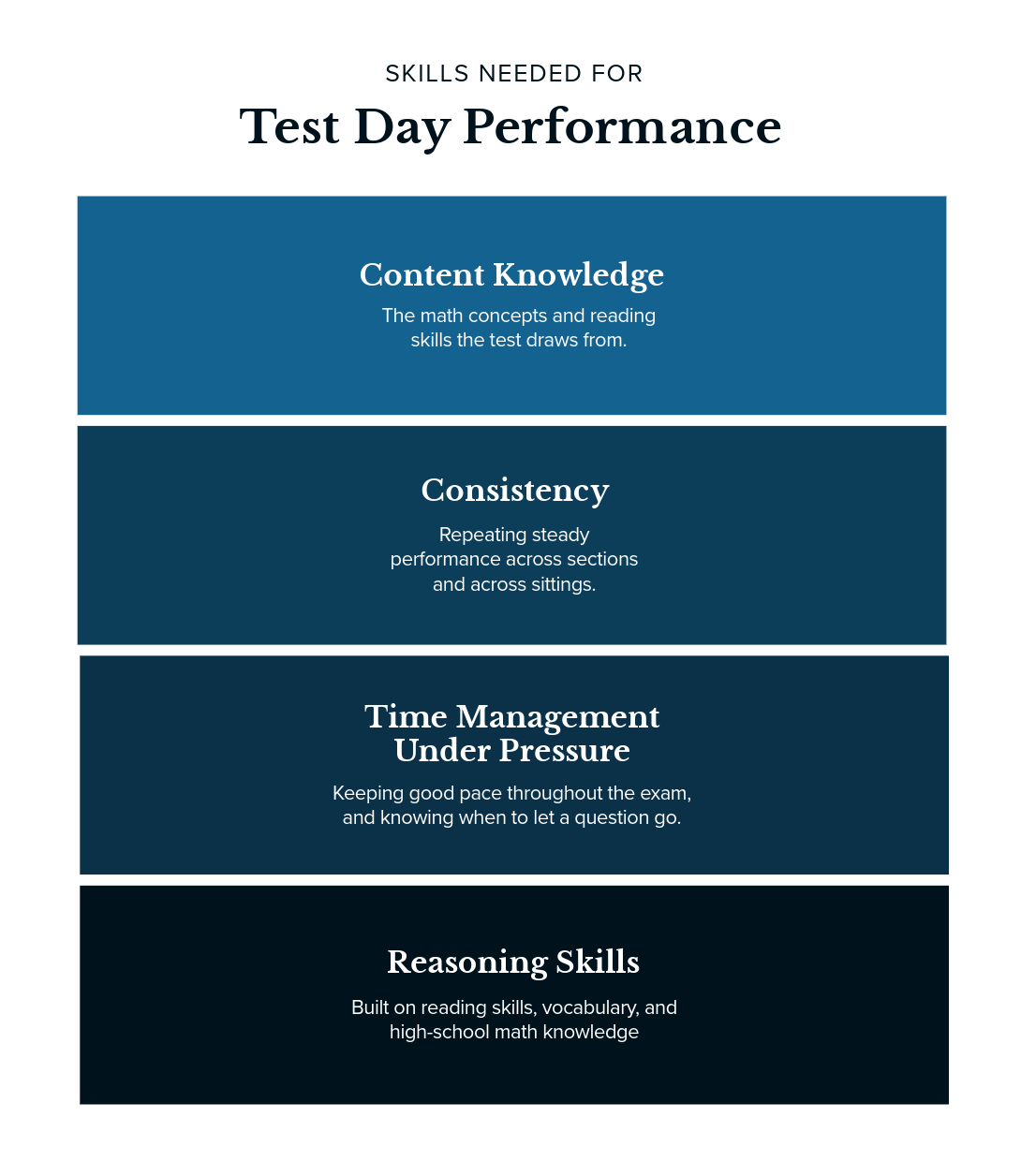
Above all, remember that the GRE® measures more than your content knowledge. Sure, it’s important to know certain math concepts and to have a decent vocabulary. But on the GRE®, it’s equally valuable to focus on:
- Managing your time well,
- Preparing to perform under pressure, and
- Building habits to ensure that you don’t make mistakes on easy questions.
Frequently Asked Questions
What does the GRE® actually test?
High-school-level math (including geometry, which is not tested on the GMAT), reading comprehension, vocabulary in context, and one 30-minute essay. It also tests more abstract skills, such as time management, composure, reasoning ability, and consistent execution on easier questions.
Is there calculus or trigonometry on the GRE®?
No. GRE® quant focuses on more fundamental math topics, such as arithmetic, algebra, geometry, statistics, probability, and number properties.
Can you skip and return to questions on the GRE®?
Yes, within each section. You can mark questions, move on, and return if time allows.
Why do people score lower on the real GRE® than on practice tests?
Usually because of time pressure, not knowledge. Test-day anxiety and rushed misreads turn a content-knowledge score into a composure score. Luckily, good time management and performance under pressure are trainable skills.