
GRE® Vocabulary: Why Word Lists Won’t Save You
Chances are, if you’re reading this, you probably came here for a word list. We’re going to try to talk you out of it. Here’s the short version of our argument against vocabulary-memorizing: there are more than 170,000 words in English, your GRE exam will contain roughly 14 vocabulary-based questions, and nobody can tell you which words will show up. Memorizing lists is one of the least efficient things you can do with your study time. What actually raises your verbal score is learning to read what a sentence is doing, and that’s a skill you build by reading, not by flipping cards.
We know that’s heresy in test-prep circles. So before we argue about it, let’s try a question.
You Can Answer These Without Knowing the Words
Don’t worry about whether you know all of the vocabulary here, just read the question below.
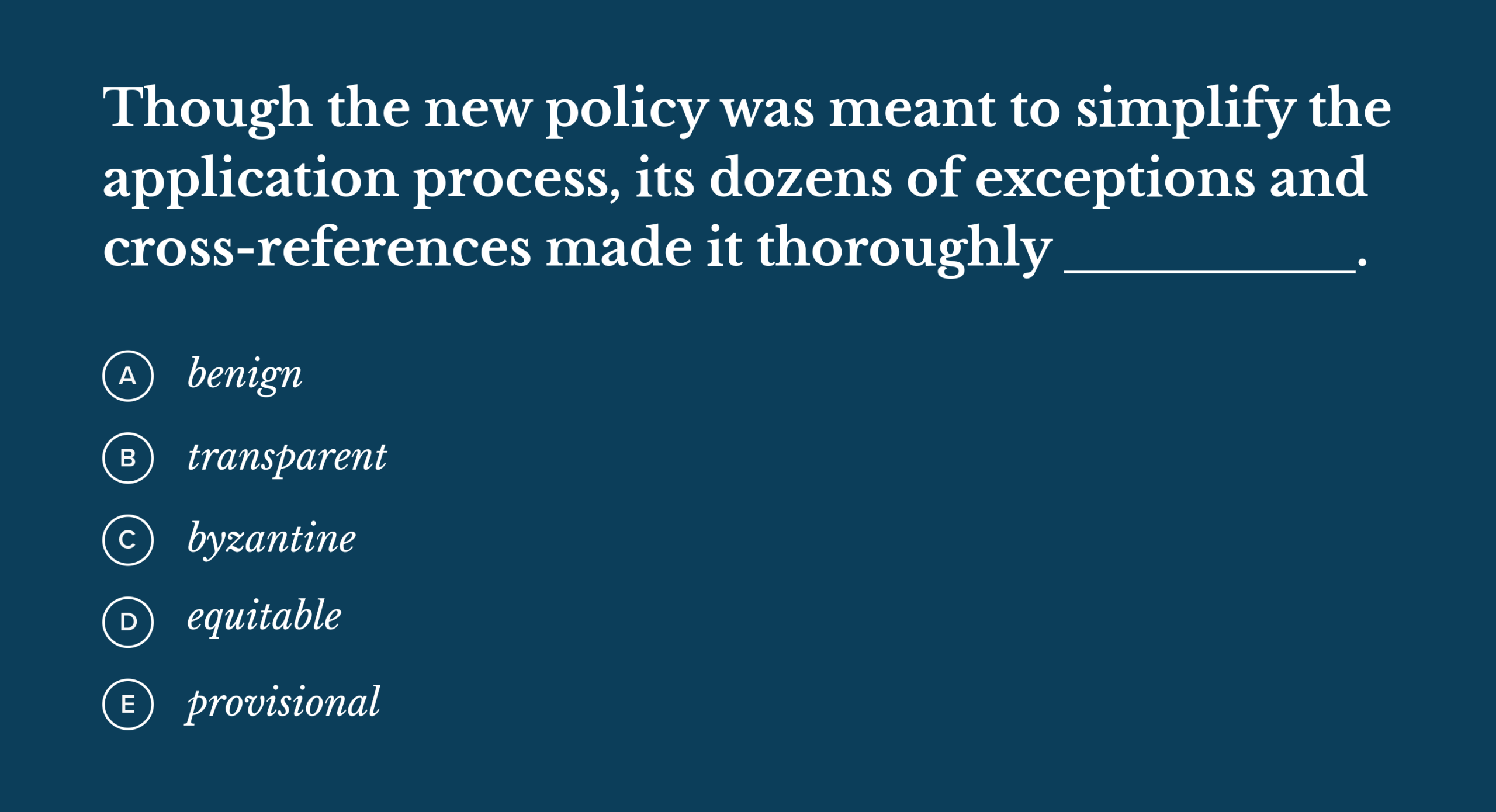
The stem of the question provides clues as to what the answer is. Let’s walk through it.
“Though” sets up a contrast with “simplify.”
“Dozens of exceptions and cross-references” looks like the thing that’s being contrasted against “simplify”. The opposite of “simplify” is “complicate”. Thus, there’s something complicated about the policy.
That’s what we’re looking for: a word that is synonymous with “complicated.”
Let’s walk through the answer choices:
- “Benign” has nothing to do with complexity. Eliminate.
- “Transparent” is the opposite of complicated. Eliminate.
- “Byzantine” is a bit of an obscure word. For this example, let’s assume we don’t know what it means. We’ll hold onto it because we’re not sure if we can eliminate it.
- “Equitable” has nothing to do with complexity either. Eliminate.
- And lastly, “provisional” doesn’t have anything to do with complexity. Eliminate.
That leaves Option C, “byzantine”, as the last word standing. Even though we don’t know what it means, we’re still able to reach the conclusion.
Notice how little vocabulary knowledge you needed to get there. You needed to notice a contrast word, follow it to the thing being contrasted, and then eliminate the four answers that weren’t about complexity.
If you can apply a method like this reliably, you can survive a shocking number of unfamiliar words. We teach a similar strategy in our guides to Text Completion and Sentence Equivalence.
Do This Before You Make Your Flashcards
Let’s suppose you’re unusually disciplined, and you actually finish a list of 1,000 GRE words. Most people who buy (or worse, create) a deck of GRE words never get past memorizing the first few hundred words, so you’re already ahead of the field.
English has something north of 170,000 words in current use. Your GRE exam will ask you roughly 14 vocabulary-based questions, drawn from a pool of vocabulary that ETS has never published (and never will). So you’ve memorized about 0.6% of the language, and you’re hoping for overlap with fourteen questions, chosen by people who are actively trying not to be predictable.
I’m not saying it never pays off. Every so often a student tells me a word from their list showed up on test day, and they’re delighted, and I’m delighted for them. I’m saying it’s a lottery ticket, and lottery tickets are a strange thing to buy with the most valuable resource you have when it comes to test prep: time.
Now think about what those same hours buy you if you spend them differently. Reading carefully and precisely helps on every single verbal question you’ll see, including the thirteen or so Reading Comprehension questions where a memorized word list does nothing at all. One skill pays across the whole section. The other pays off once, if you’re lucky. If it pays off twice, then it’s definitely time to buy a lottery ticket.
Memorizing For GRE Vocabulary Probably Makes You Worse At It
Most people study vocabulary through visual repetition: stare at the word, stare at the definition, repeat until it sticks. It feels like learning. In one peer-reviewed study though, students who learned that way performed worse on a subsequent vocabulary test than students who didn’t. Not marginally worse in a way you could argue about. Worse.
A flashcard gives you a word’s dictionary definition, cleanly separated from any sentence it can feasibly be used in. The GRE, meanwhile, almost never asks what a word means in isolation. It inherently tests you on whether you can identify the job a word needs to perform in that sentence. That’s instead asking for your judgment about usage, connotation, and register – none of which fits on the back of an index card.
So students who’ve memorized heavily often end up in the worst of both worlds: they recognize the word, which stops them from eliminating it, but they can’t feel whether it belongs, which is what the question was actually about.
So, How Should You Study for GRE Vocabulary?
Reading. Lots and lots of reading.
Over the months of your prep, choose reading material that’s harder than what you’d choose for pleasure. This is the one thing I’ve consistently seen move verbal scores over the years, so I’ll take unsatisfying-yet-effective prep methods over satisfying-yet-useless prep methods.
Aim for fifteen to thirty-five minutes a day of genuinely challenging reading. Research suggests you want to be recognizing somewhere between 85 and 97 percent of the words on the page, which is a technical way of saying you should be a little uncomfortable. If you’re gliding through, the material is too easy to be doing anything for you. Our nonfiction reading list can point you towards some material to get you started, alongside our fiction list.
When you hit a word you don’t know during your reading, don’t look it up right away. Sit with it, see if you can work out what it probably means from the sentence around it, make your best guess, and jot it down on a physical or digital notepad. Then, keep reading. At the end of your session, go back and look up the words you flagged and find out how you did.
Please don’t reverse that order, because the guessing is the exercise. Working out an unfamiliar word from context is exactly what Text Completion and Sentence Equivalence ask you to do, so every strange word you meet while reading is a free practice question with instant feedback. Look it up the moment you meet it and you’ve converted that free practice question into a flashcard, which brings us back to where we started.
One honest caveat about timeline. Building a real working vocabulary this way takes six months or more, because that’s simply how long it takes to accumulate enough encounters with enough words. If your test is three weeks away, this isn’t your play, and I’d rather you spent those three weeks drilling the method in our Text Completion guide until it’s automatic.
What to Do on Test Day When a Word Ambushes You
It will happen. It happens to everyone, including people who read constantly and score in the 99th percentile. The goal isn’t to eliminate unfamiliar words. Instead, you’re trying to stop them from costing you questions.
Don’t eliminate a word just because you don’t recognize it. This is the most expensive habit in GRE verbal. Difficult words are just as likely to be correct as easy ones, so a policy of crossing them out equals a policy of crossing out the answer on a regular basis.
Don’t pick it for that reason either. “It sounds fancy, so it’s probably the answer” has ruined at least as many questions as it’s saved. The test isn’t rewarding obscurity for its own sake.
Work the sentence before you look at the answers. Decide what the blank has to accomplish, in your own plain words, and only then read the choices. If you do this properly, you can often eliminate three or four options confidently, and find yourself holding one word you can’t define. This is a good thing, because that’s probably your answer.
On Sentence Equivalence, let the pair requirement help you. You need two words that leave the sentence meaning the same thing. So if you’re confident about two words but they clearly don’t mean the same thing, you can apply some logic to the situation. You know at most one of them can be right, and suddenly that unknown word looks like a much more plausible partner for one of them.
And if a question is genuinely drowning in words you don’t know, mark it, guess, and move on. Staring at a word has never once caused its definition to surface. Your time is better spent on the questions where you can actually do something.
The One Time I’ll Endorse a Vocabulary App
If you’re on a train, or standing in a grocery line, or waiting for a meeting to start with eight minutes you were going to spend scrolling anyway, then sure, open the app. It doesn’t cost you focused study time, and a few extra words in your head won’t do you any harm.
What I’d hate to see is you trading an hour of reading, or an hour of official practice questions, for an hour of flashcards. That’s the trade that costs you points, and it’s the one that feels most like progress while you’re making it.
So no, we’re not going to send you our word list. But if you email us asking for one, we’ll happily send you a reading list instead. If you actually use that reading list for six months, you’ll be in far better shape than the version of you who memorized 500 definitions.
Frequently Asked Questions
How many words do I need to know for the GRE?
There’s no list to memorize. English has more than 170,000 words in use, and your exam includes roughly 14 vocabulary-based questions. Additionally, ETS doesn’t publish the pool of questions that vocabulary words are drawn from. Reading widely and learning words in context does far more for your score than any word count you could hit.
Are GRE vocabulary flashcards worth it?
Mostly no. One peer-reviewed study found students who learned through visual repetition performed worse than peers who didn’t, and flashcards teach dictionary definitions when the GRE tests usage. Use an app during dead time if you enjoy it, but don’t trade actual study hours for it.
How long does it take to improve GRE vocabulary?
Six months or more, since it grows through accumulated reading rather than cramming. If your test is a few weeks out, spend that time on the Text Completion and Sentence Equivalence method instead, which improves much faster.
What should I do if I don’t know a word on the GRE?
Keep it in play. Never eliminate or select a word just because it’s unfamiliar. Work out what the blank needs, eliminate the options you’re confident don’t fit, and if the question is full of unknowns, guess and move on.