
GRE® Geometry
Geometry has a reputation for being the scariest part of GRE quant, usually because it’s a topic people haven’t studied since ninth grade. If your last encounter with a circle theorem was years ago, a little anxiety is certainly understandable.
In practice, however, GRE geometry is narrower than most people expect. You won’t have to write proofs, you don’t need trigonometry, and the number of formulas required is pretty manageable.
Here’s what’s actually tested when it comes to GRE geometry.
What GRE Geometry Covers
You might recognize some of these topics from math class in high school:
- Lines and angles, including parallel lines with transversals.
- Triangles, including right triangles, equilateral triangles, and the Pythagorean theorem.
- Circles, including area, circumference, and arcs.
- Quadrilaterals and polygons, including area, perimeter, and interior angles.
- Three-dimensional figures, including rectangular solids and cylinders.
- Coordinate geometry, including slope, distance, and the equations of lines.
Notice that proofs and trigonometry are missing from this list. While taught in high school, they are entirely absent from the GRE.
One additional note: if you’re switching from the GMAT to the GRE, geometry is one of the biggest differences between the exams, as the current version of the GMAT has dropped the subject entirely. If you’d like a more thorough comparison between exams, visit GMAT vs. GRE vs. EA: Which Test Should You Choose?
The Geometry You Need in Your Head
For many GRE quant questions, formulas can be of limited value. In general, the exam writers are more interested in your ability to reason than your capacity to regurgitate formulas. When it comes to geometry, however, there are definitely a handful of formulas you’ll need to know. Luckily, there aren’t too many of them, and they’re pretty basic. As a result, you won’t need any long cheat sheets.
Before we get into it, however, here’s a quick word about formulas in general. More specifically, we’d like to show you why rote memorization of long formula lists isn’t the best approach.
Let’s talk take cylinders as an example. If you’re studying for GRE geometry, there’s two ways you could proceed here:
Option 1: You could memorize the formula for the volume of a cylinder, and another formula for its surface area.
Volume = πr² × h
Surface Area = 2πr² + 2πrh
Unfortunately, there a few reasons why this isn’t a great approach.
First, it’s not a particularly easy task to memorize and retain these equations as written. It burns limited study time, takes up precious brain space, and it’s easy to mess them up on test day.
Second, memorizing formulas is a strategy that scales terribly. If you try to memorize the volume and surface area formulas for all the common 2D and 3D shapes on the GRE, you’d end up with a painfully long formula list. The onus is also on you, then, to make sure you retain and recall each formula perfectly on the exam.
Lastly, something that might not be so obvious – rote memorization can turn you into a rigid thinker. If you don’t understand the logic underlying a formula, you can’t adapt that logic to varying or unexpected situations. If you’re a rigid thinker who relies on rote memorization, small changes or variations to familiar situations can throw you off completely.
So if rote memorization isn’t the way to go, what should you do instead? Let’s consider another approach.
Option 2:
Instead of memorizing those long formulas, let’s start with some really basic ones. Notice these are all quite short and fairly intuitive. They also apply to many different situations, not just a few, so learning them is a high-yield investment.
- Circles: area = πr²
- Rectangles: area = length x width
- 3-D shapes: volume = base x height
- .
Now, instead of writing yourself a cheat sheet of long formulas, take a look at a cylinder and really think about it. Doing so, you might realize it’s really just a bunch of circles stacked on top of each other.
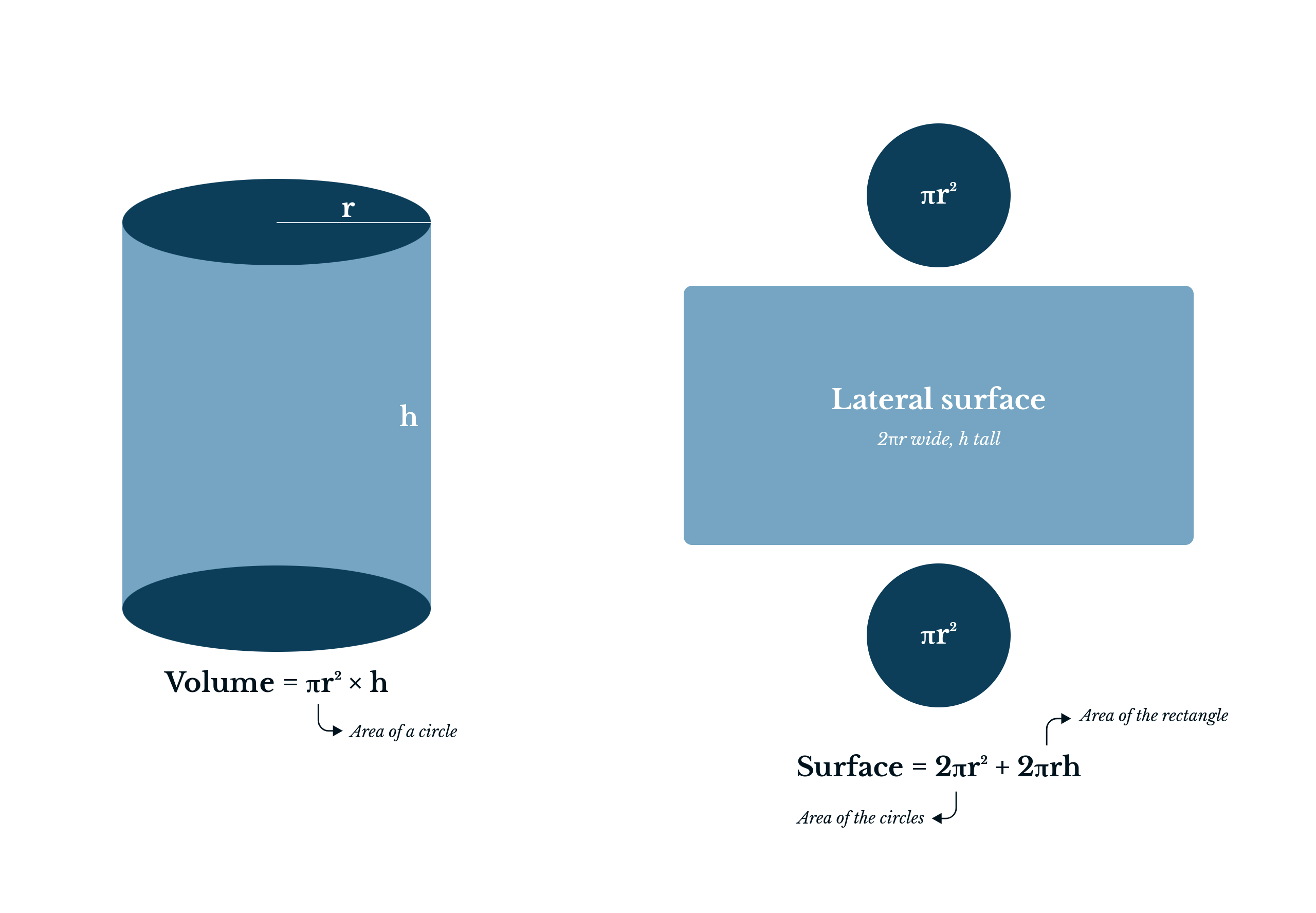
Notice that a cylinder is really just a circle that’s been dragged up to a height of h. What does that mean in math-speak?
Volume of a cylinder = (area of base circle) x (height of cylinder)
Hey, that looks a lot like our really basic volume formula – in other words, volume = base x height. Add the area of a circle formula, plus a little logic, and we’re done.
For the surface area of a cylinder, let’s imagine a soup can for a moment. Pretend you’re examining one in your hand. There’s a circle on the top and bottom that form the top and base of the can. Then, if you peel off the label and flatten it out – voila, you get a a rectangle! We can make a surface area equation out of this.
Surface area of a cylinder = (the area of two identical circles) + (circumference of the circle times the height of the can).
This, as I’m sure you’ve guessed, is the same as:
Surface Area = 2πr² + 2πrh
All we needed to know was a basic volume formula (volume = base x height), how to calculate the area of a circle, the circumference of a circle, and the area of a rectangle. Note that there’s no specific formula for a cylinder in that list, which saves us from memorizing those complicated formulas from Option 1.
More importantly though, if you go with Option 2, it makes you a better problem solver. Because now you know how to handle a cylinder question even if it’s presented to you in an unfamiliar way. You’re not getting by with a rigid formula. You’re thinking about the logic underlying that formula, which is something the GRE really cares about.
This is why we advocate for a short formula list, along with a deep understanding of the concepts embedded in that list. Because if you can grasp a small number of simple relationships deeply enough, you can build the more complicated formulas yourself. Not only will this decrease your chances of misremembering a formula, it will make you a better, more flexible problem solver.
Here’s the short list of geometry formulas to get you started. As you’ll notice, these are quite rudimentary – you might remember them from junior high school.
- Circles: area = πr², circumference = 2πr
- Triangles: area = ½ × base × height; the Pythagorean theorem, a² + b² = c²
- Angles: a triangle’s interior angles sum to 180°, a quadrilateral’s to 360°
- Rectangles and boxes: area = length × width; volume = length × width × height
- Coordinate geometry: slope = rise over run, and the line equation y = mx + b
- Volume = base x height
As you study more and encounter more problems, your conceptual understanding will grow, and you may add a few more formulas here and there. The point we’re trying to make here: don’t reduce your geometry studying to memorizing a long list of formulas, and assuming you’ve done the job. Rather, as you study geometry, make sure you’re always thinking conceptually, trying to minimize your list of formulas, and anchoring any formulas you do memorize in logic as much as possible.
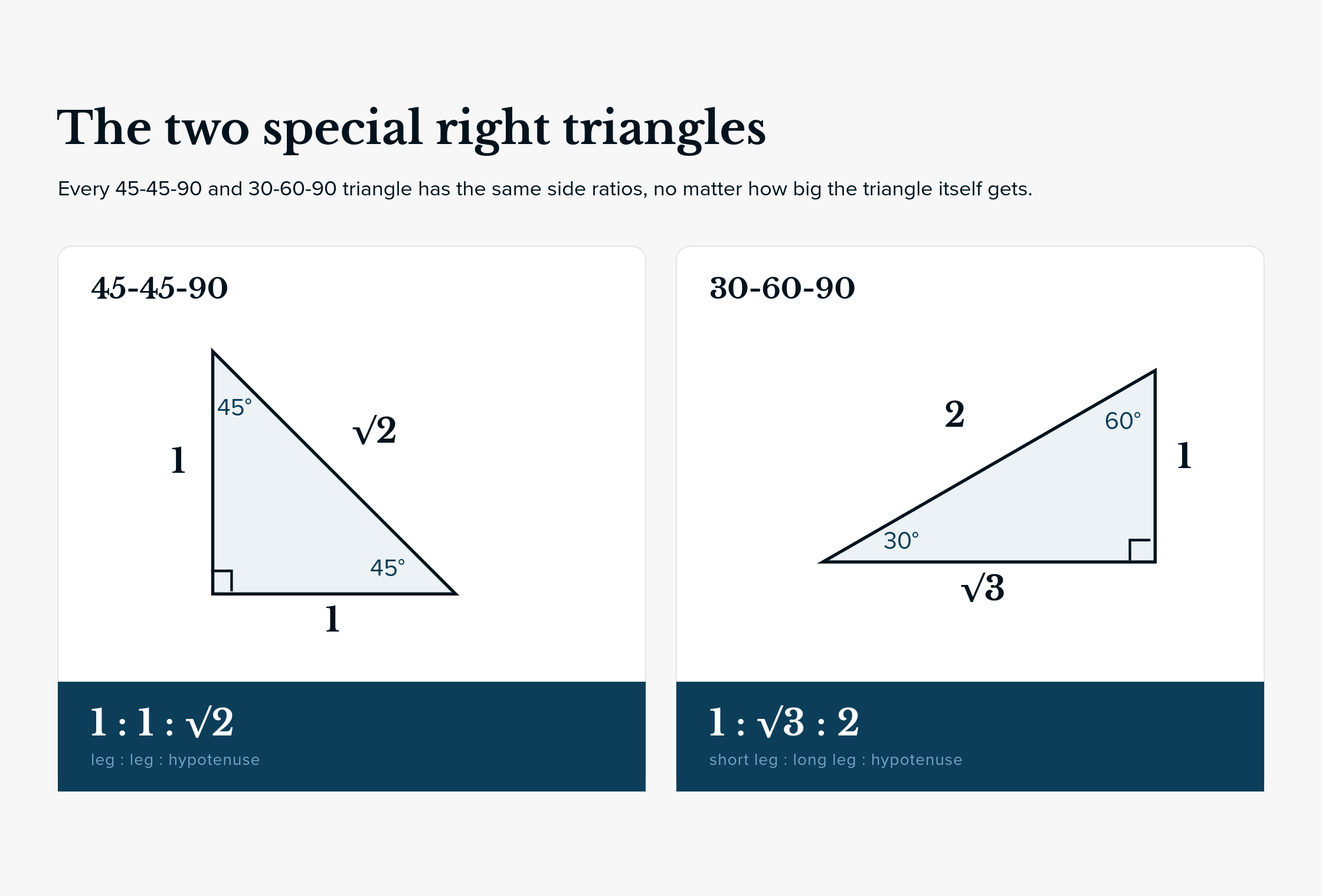
You’ll also want to quickly memorize the two special right triangles, shown below, alongside their side ratios.
We realize that many GRE study guides will include much longer lists of formulas to memorize. But for the reasons discussed above, we always discourage our students from over-relying on such lists. As noted in our cylinder example, instead of memorizing an excessive number of formulas, it’s better to arrive at them logically, using more basic building blocks. Implementing that approach will not only reduce your memorization burden, it will make you a deeper, more creative problems solver.
An Important Note About Scale
Looks can be deceiving when it comes to geometry on the GRE, because geometric figures aren’t necessarily drawn to scale (with one caveat, noted below).
To give a specific example, let’s say you encounter a four-sided figure that looks like a square. It has four sides that seem to be of equal length, and the angles between these sides seem to be 90°. So can you conclude, based on its appearance alone, that this shape is a square? Definitely not! To conclude that a four-sided shape is really a square, you’d need to be given more explicit information. That is, you’d need to be told the four sides are of equal length, and that each angle is 90°. Only then could you correctly conclude the figure is a square.
Overall, the geometry diagrams on the GRE will show you how the pieces relate, which is crucial information. But you should never base your calculations on visual estimation alone. Work from what you’re told, not what you think you see. If the question labels a side or states an angle, use that. If it doesn’t, don’t assume the figure is drawn to scale.
All that being said, there’s one exception to this general rule – coordinate geometry figures are drawn to scale, since they are based on an actual grid. Keeping this in mind can be crucial when analyzing coordinate geometry diagrams.
One final note: the issue of scale often shows up on Quantitative Comparison questions with a geometry component. In these cases, a diagram might lead you believe that one quantity is bigger than another, based solely on that quantity’s appearance. But unless you can ground this conclusion in solid logic or clear calculation, you’ll want to avoid making it.
Geometry Questions Can Catch You Out
Here are some common mistakes we see when it comes to GRE geometry.
Solving for more than the question asked. Geometry questions often give you enough information to find several things, and it’s easy to start solving for values you don’t necessarily need. Write down what’s actually being asked before you start solving.
Mixing up radius and diameter. This is one of the most common errors we see on circle questions. The question writers know this too. Make sure you read with precision and understand exactly which value is being asked for. Similar confusion can happen with word pairs such as area and perimeter, length and width, or circumference and area.
Over-calculating. The on-screen calculator can be quite tempting when it comes to geometry. For example, you might plug 3.14 into the calculator instead of working with π. The calculator will happily spit out a decimal approximation, but it’s often easier to leave π in place and work around it. Check the answer choices before you start calculating.
How to Study GRE Geometry
If it’s been a while, start with our short list of formulas above. Aim for genuine understanding of the concepts rather than recall. While the list we included doesn’t exhaust every last geometry concept, it has plenty to get you started. Using those basic building blocks, you’ll be able to build out additional, more complex relationships that will be crucial on the exam.
Once you’ve drilled and practiced those basic building blocks, you can move on to official questions. As you do so, make sure you’re always trying to think conceptually, anchoring your work in logic as much as possible. Whenever you miss a question, be honest with yourself about why, and analyze every mistake in depth.
If you’d like a broader understanding of how GRE Quant works, visit GRE Quantitative Reasoning explained.
Frequently Asked Questions
Is there geometry on the GRE?
Yes. GRE quant includes lines and angles, triangles, circles, polygons, three-dimensional figures, and coordinate geometry. There are no proofs and no complex trigonometry.
Are GRE geometry figures drawn to scale?
Not necessarily, apart from coordinate geometry figures. Work from the labels and given information rather than from how the drawing looks.
Do I need a GRE geometry formula sheet?
Not really. A handful of relationships will carry you through almost everything. Most of the formulas on a typical cheat sheet can be derived from those, and deriving them is more reliable than remembering them.