

How to Get a Perfect GMAT Score. Sort Of.
The short version from someone who actually did it: don’t waste your time trying. I scored a perfect 800 back in 2011 (an 805 on today’s scale), and the gap between a great score and a perfect one is mostly luck. Only about one in 1,000 test-takers scores a 765 or above, an 805 is far rarer still, and none of it will do much for your business school applications.
If you want a smarter use of your energy, start with How to Study for the GMAT. But I’ve been asked about the perfect score literally hundreds of times over the years by GMAT students, prospective students, random people in the GMAT forums, and plenty of others. So here’s the honest truth: how hard it is to get a perfect score, whether you have to answer every question correctly, and whether any of it matters.
How Hard Is It to Get a Perfect GMAT Score?
First, a quick housekeeping note: back in the day, 800 was a perfect score on the GMAT. The exam was rescaled in 2023 so that all total scores end in a 5, which means that 805 is a perfect score on the current version of the test.
GMAC doesn’t tell us exactly how many people earn a perfect 805 each year, but the percentile data gives us a pretty good idea of the neighborhood. Only the top 0.1% of test–takers, roughly one out of every 1,000, score a 765 or above. Do some back-of-the-envelope math on the number of people who take the GMAT in a typical year, and you’re left with a group of maybe 100 people, give or take. Of those, only a fraction climb all the way to an 805.
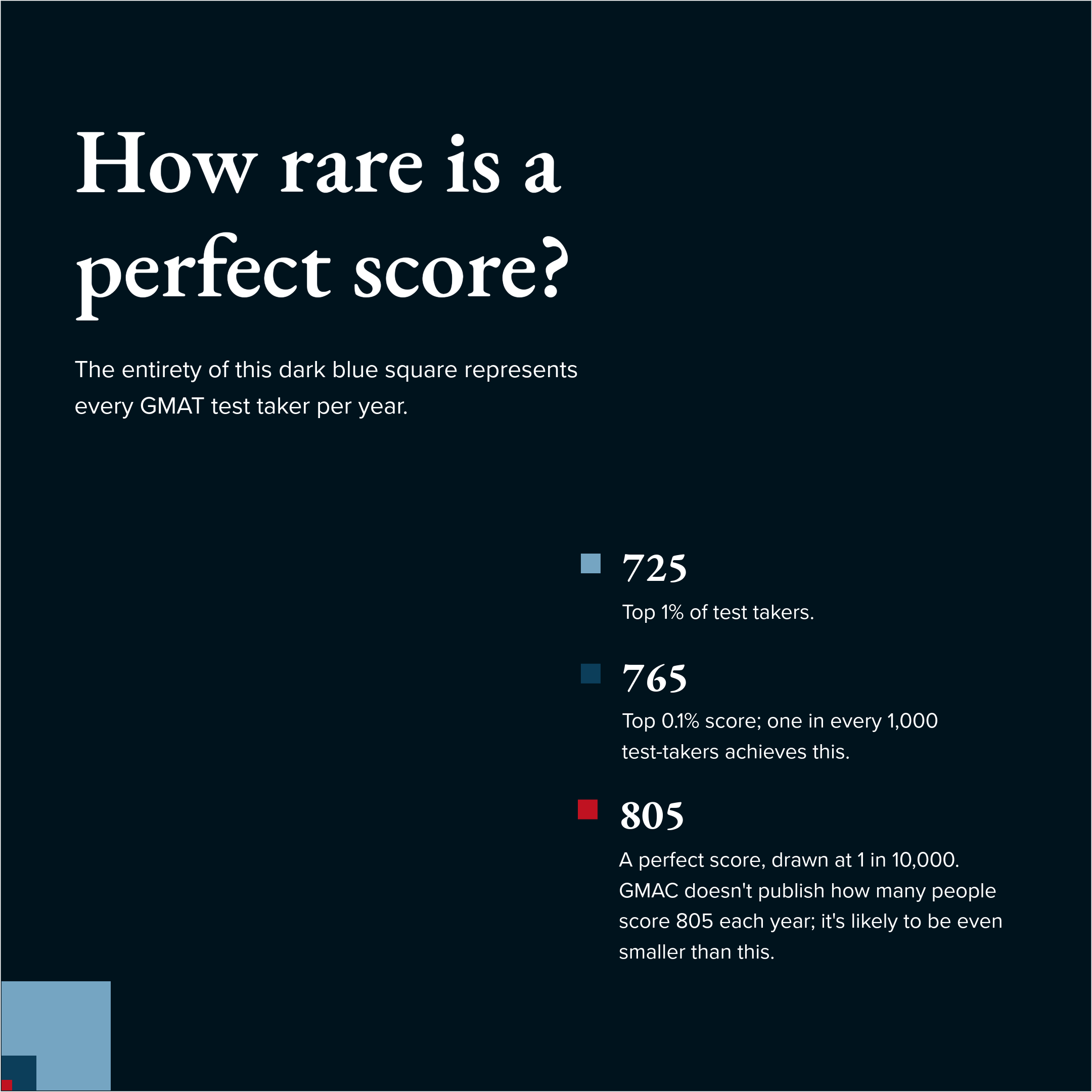
Why is it so hard? A few reasons. The GMAT is an adaptive exam, so if you’re crushing it, the questions get harder, and they can get really tough. You’re also juggling three sections and a whole pile of question formats, so a flawless performance demands an absurd breadth of skill, airtight time management, and a level of precision that most humans simply don’t have.
And I mean “humans” literally. We make mistakes. Anybody who can score in the 700s on this exam is brilliant at taking standardized tests, and the difference between a 725 and an 805 is just a couple of questions on a very difficult exam. That’s why almost nobody gets all the way there.
Do You Have to Answer Every Question Correctly to Get an 805?
Honestly? Nobody outside of GMAC knows for sure. Plenty of details about the GMAT’s scoring algorithm are kept under wraps, but here’s what we can say.
Some GMAT questions are experimental. They exist to help GMAC test out new material, they’re scattered randomly throughout each section, and they don’t count toward your score at all. You can absolutely miss experimental questions and still walk away with a perfect 805.
Can you miss a scored question and still get an 805? We genuinely don’t know. The only guarantee is the obvious one: answer every question in a section correctly, and you’ll earn a perfect score on that section, no matter what.
For whatever it’s worth, on the old version of the exam, I’m 99% sure that I missed at least one question when I earned my 800. The GMAT didn’t provide detailed analytics for test-takers back in 2011, so I can’t actually check. But as soon as I finished the exam, I worked through every Quant question I could remember, and I’m pretty certain that I missed at least one. Maybe more.
Back then, you could miss a bunch of questions and still earn a “perfect” Quant score of 51. (In case you’re wondering: yes, 51 used to be a perfect Quant score. The test was rescaled in early 2024, and 90 is a perfect Quant score on the current GMAT.)
Does a Perfect GMAT Score Impress Admissions Committees?
In all honesty? Not really. Once you get above a certain level, nobody is terribly impressed by the difference between a student with a 725 and one with an 805.
Business school admissions is multifaceted. Committees are weighing your work experience, your essays, your recommendations, your goals, and a pile of other characteristics. Your ability to be ludicrously precise on a standardized exam, as opposed to just really, really good at it, is meaningless to them. As it should be.
This may surprise you, but schools reject a shocking proportion of applicants with perfect scores. 800s and 805s are rare, but the people who have them aren’t guaranteed anything at all in admissions.
So if you’re tempted to chase an 805 for the sake of your application, don’t. Put that energy into the rest of your candidacy instead.
OK, But Did You Actually Get a Perfect GMAT Score?
Yup. Back in 2011, I earned a perfect 800 on the GMAT. I don’t really think of it as much of an achievement, to be honest, because there was some dumb luck involved.
In all of my previous GMAT exams, including the official mba.com practice tests the first time I took each of them, I always fell short of a perfect Verbal score. I inevitably missed a few questions, partly because I tend to lose focus at the end of the GMAT, but mostly because I screw stuff up sometimes, just like every other human.
If you’ve ever taken the GMAT, GRE, or LSAT, I’m sure this part will sound familiar: I inevitably face a few “coin tosses” on Verbal, questions where I’m down to two answer choices but I’m not terribly confident in the final selection. (Incidentally, if you’re down to two choices on a GMAT Verbal question and you select the wrong one, that’s not necessarily a sign that you were “close.” It’s usually a sign that you misread something in the passage.
But when I finally got a perfect GMAT score, that didn’t happen at all. I was pretty much 100% confident on every Verbal question. That has never happened to me on any GMAT, LSAT, or GRE exam before or since, including the times when I got a perfect 340 on the GRE. Those GRE exams felt absolutely brutal at times, and I was shocked that my GRE score wasn’t lower in the end.
Most importantly, all four of my GMAT Reading Comprehension passages were bizarrely interesting when I got that 800. I still remember one of them. It was about a type of plant called dodder that apparently has a sense of smell. Amazing! Again, that’s never happened before or since. When have you ever had four legitimately interesting GMAT Reading Comprehension passages on the same exam?
So there you go: yes, I’m pretty good at this GMAT thing, but the difference between, say, a 780 and an 800 is basically luck, or measurement error, if you prefer the technical term. GMAC’s own psychometricians say a total score can fluctuate by roughly 30 points from one sitting to the next through normal measurement error alone. At the very top of the scale, that noise is the whole ballgame.
Could I do it again? Well, I’m banned from taking the test, so it’s a moot point. After the 800, I received a nice letter from the GMAT Office of Test Security informing me that I would need a damned good reason if I ever wanted to take it again. And I don’t have a damned good reason. “I’m a GMAT tutor and I want to help my GMAT students beat your stinking exam” isn’t going to fly with the GMAT test security folks. My mba.com account was suspended too, though the GMAT will still happily accept my money whenever I want to buy GMAT practice tests or other prep materials from them.
But banned or not, I’ll be honest with you: I think a repeat performance would be a real challenge. The exam has expanded its scope since 2011, and I don’t know whether I still have the precision to get every question, or nearly every question, right. Nobody should be confident about that. That’s kind of the point.
One more thing, since people ask: did I study for it? Sort of. I started working as a GRE and GMAT test prep tutor in 2001, a decade before the perfect score. I’m still “studying” now, since I work with GMAT students almost every day. Unless you want to become a GMAT tutor yourself, “studying” for anywhere close to a decade is an epic waste of your time.
Do Perfect Scorers Make Better GMAT Tutors?
Emphatically, no. I’ve never believed that a perfect score is an important qualification for the best GMAT tutors, and I say that as a guy with a perfect score.
Being bizarrely good at test-taking doesn’t mean you’re a good communicator or good at reading people. Both are crucial skills when it comes to teaching. A flawless score tells you nothing about someone’s actual teaching ability.
To be a great instructor in anything, you need an expert-level command of the material. On this exam, the top 1% of test-takers score a 725 or above, and I’d call that an expert-level command. If you want to argue for the top 0.1% instead, fine. But past that point, extra precision doesn’t buy you anything as a teacher.
The things that actually make somebody great at teaching are entirely different: the perceptiveness to understand how your students’ brains work, the ability to connect with them, the ability to present material in a way that’s compelling and engaging, and a deep understanding of test-taker psychology. I could go on and on.
A great score is a prerequisite. A flawless one just tells you that a particular test-taker is a machine who almost never makes mistakes, and that’s not a quality I care about in a teacher. There’s expertise that comes with a 725 or a 765. There’s mind-numbing precision, and maybe some luck, that comes with an 805. When I’m evaluating tutors, I care about the first thing, plus a whole lot of qualities that have nothing to do with test scores.
Spend Your Energy Where It Counts
So, no: there’s no secret method for scoring an 805, and there’s no practical reason to want one anyway. A perfect score will not help you get into a great business school, and it won’t make anybody a better tutor.
If you’re wondering how to get an 800 or an 805 on the GMAT, don’t waste your time thinking about that. Go write an interesting MBA essay instead, or better still, go eat a tasty snack.
Frequently Asked Questions
What is a perfect GMAT score now?
On the current GMAT, 805 is a perfect total score (the old version topped out at 800; the exam was rescaled in 2023 so that all total scores end in a 5). A perfect Quant score is now a 90, whereas it used to be a 51.
How rare is a perfect GMAT score?
GMAC doesn’t publish exact counts, but only the top 0.1% of test-takers, roughly one in 1,000, score a 765 or above, and perfect 805s make up a small fraction of that group.
Do you need a perfect GMAT score to get into a top business school?
No. An 800 or 805 won’t get you in, and schools have always rejected a shocking proportion of perfect scorers. Committees care about a strong score plus the rest of your application, not perfection.
Can you miss questions and still get a perfect GMAT score?
You can certainly miss experimental questions, which don’t count toward your score, and still earn an 805. Can you miss a scored question and still get a perfect score on the current exam? Nobody outside GMAC knows for sure.
Are there GMAT prep materials that will get you a perfect score?
No. Using official GMAT materials is always a good idea, but there’s no magical resource that will carry you to an 805, and anybody who claims otherwise is trying to sell you something.