

What Is on the LSAT®?
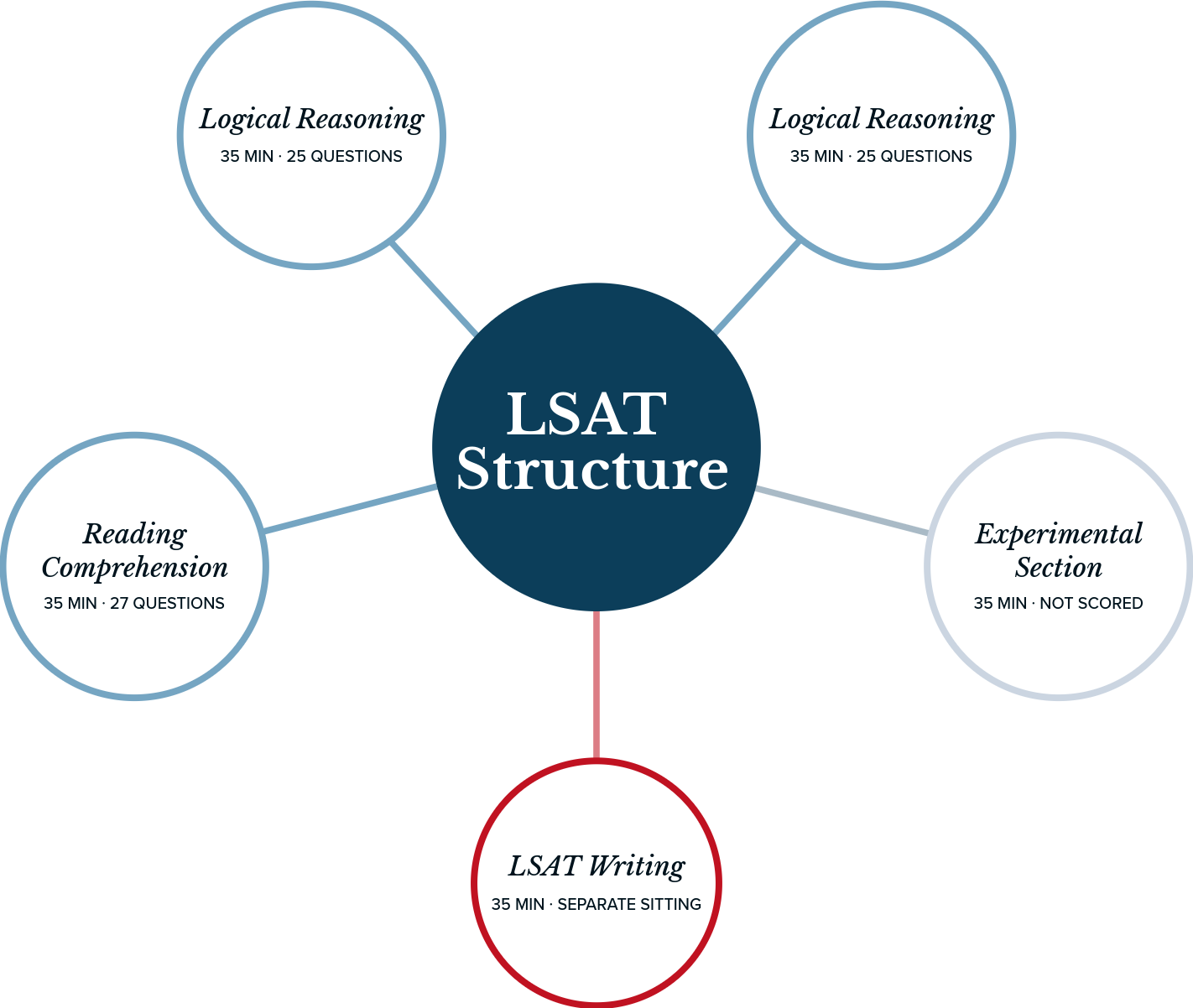
The LSAT® consists of three scored sections:
- Two Logical Reasoning sections (about 25 questions each, 35 minutes per section)
- One Reading Comprehension section (about 26-27 questions, 35 minutes)
In addition to the three scored sections, you’ll complete:
- An “experimental” section that is unscored. This section will be an extra Logical Reasoning or Reading Comprehension section.
- A 35-minute writing section. Your essay will not be graded and will not impact your LSAT® score, but it will be sent to law schools along with your LSAT® score report.
(Looking for logic games? They’re gone, see below.)
LSAT® Logical Reasoning (“Short Arguments”)
Each LSAT® Logical Reasoning (LR) section contains about 25 multiple choice questions. These questions follow a short passage that presents an argument. After reading that argument (which is typically less than 100 words), LSAT® test-takers are asked to do tasks such as the following:
- Strengthen the argument
- Weaken the argument
- Identify the role of different segments of the argument
- Identify assumptions underlying a conclusion
- Resolve an apparent paradox or discrepancy
- Infer a conclusion based on given facts
With two scored sections, Logical Reasoning makes up roughly two-thirds of your LSAT® score, so it deserves a higher proportion of your study time. For more on how to approach these questions, please check out our Beginner’s Guide to LSAT® Logical Reasoning.
LSAT® Reading Comprehension (“Long Passages”)
Each LSAT® Reading Comprehension (RC) section contains four passages that are about 3 to 5 paragraphs in length. Passages often cover a topic such as economics, science, art, or history, and are followed by 5 to 8 multiple choice questions.
The point of these LSAT® Reading Comprehension passages is not to test subject-specific knowledge. Instead, they test the ability to read and comprehend written material, even when it may cover an unfamiliar subject. On RC questions, test-takers are often required to:
- Identify primary purpose and main ideas
- Infer conclusions
- Discern logical structure
- Recognize style and tone
For more on how to approach these questions, please check out our Beginner’s Guide to LSAT® Reading Comprehension.
What happened to LSAT® Logic Games?
If you started researching the LSAT® a while ago, you might remember the Analytical Reasoning section, better known as “logic games”: a complicated, madness-inducing version of the sorting and matching puzzles you can find in the back of a newspaper.
LSAC removed logic games from the LSAT® in August 2024. In their place, the exam now includes the second scored Logical Reasoning section. If you’ve been dreading diagramming band lineups at a music festival, you’re off the hook, but the flip side is that Logical Reasoning now dominates the exam, so precision reading matters more than ever.
The LSAT® Experimental Section
Only three sections actually contribute to your LSAT® score: two Logical Reasoning sections and one Reading Comprehension section.
However, you’ll encounter one additional section that is not scored. This section is included so that questions can be tested out before they appear in future versions of the LSAT®.
Because the experimental section is an extra LR or RC section, you’ll see either three Logical Reasoning sections or two Reading Comprehension sections on test day, and you won’t know which of the matching sections is graded and which is experimental. That means that you need to treat every section as if it’s scored: you risk ruining your LSAT® score if you slack off because you think that a particular section is unscored.
The LSAT® Writing Sample
The LSAT® Writing Sample:
- Does NOT impact your LSAT® score, and
- Is NOT a big factor in law school admissions.
… so, you can relax.
You don’t have to complete the writing sample on the same day that you take the LSAT®: you can take it starting 8 days before your LSAT® test date, or any time after. However, you won’t be able to see your LSAT® score until you submit the writing sample, so it’s probably best to knock it out sooner rather than later.
Here’s how it works: You complete the 35-minute LSAT® Writing section on your own computer, just make sure that you meet LSAC’s space and technical requirements, and go from there. LSAC’s Writing FAQ covers the process in detail. (Fun fact: it’s ok if your pet wanders into the room while you complete your essay, but other humans are strictly prohibited.)
About the Writing Prompt
LSAC updated the writing section in 2024: it’s now called LSAT® Argumentative Writing. Instead of the old “pick between two options” scenario, you’ll be given a debatable issue along with several different perspectives on it. Your job is to take a position and write a persuasive essay defending it, while engaging with the other perspectives.
There is no word limit, but you only have 35 minutes to write once the prewriting period ends. So, keep your essay tight and well-organized to ensure that you finish on time.
Why LSAT® Writing isn’t very important for law school admissions
Again, the LSAT® writing sample doesn’t impact your LSAT® score. In fact, it isn’t scored at all: it’s simply sent along to schools with your LSAT® score report.
You’ll also provide the schools with other examples of your writing, such as your statement of purpose or other application essays. These other writing samples can tell a school much more about your story than the LSAT® writing sample can.
The purpose of the LSAT® writing sample is to show schools how well you write under time pressure and without the assistance of an editor. This might be important for certain candidates if, for example, an admissions official has some reason to doubt the candidate’s writing ability.
However, it’s unlikely that anyone takes the time to carefully read most LSAT® writing samples when considering an application. There are just too many other data points that offer better insight into a candidate’s ability to succeed in law school.
Frequently Asked Questions
How many sections does the LSAT® have?
Four on test day (two scored Logical Reasoning, one scored Reading Comprehension, one unscored experimental), plus the separately-scheduled LSAT® Writing section.
Does the LSAT® still have logic games?
No. Analytical Reasoning was removed in August 2024 and replaced with a second scored Logical Reasoning section.
How long is the LSAT®?
Four 35-minute sections with a 10-minute break in the middle, roughly two and a half hours of testing, plus the 35-minute writing section on your own schedule.
How many questions are on the LSAT®?
About 100 multiple-choice questions across four sections on test day, but only three of those sections (roughly 75-77 questions) count toward your score. The fourth is an unscored experimental section. LSAT® Writing is completed separately and doesn’t affect your score.