

GMAT Testing Accommodations: How They Work and How to Apply
GMAT testing accommodations modify standard testing conditions for candidates with a documented disability or medical condition. Accommodations are completely confidential – schools will never know whether you took the exam with accommodations.
Accommodations exist for a simple reason: the GMAT is intended to measure your quantitative, verbal, and data insights skills, not the impact of a condition like ADHD, dyslexia, or anxiety.
What Are GMAT Testing Accommodations?
GMAT testing accommodations create equitable access for candidates whose disability or medical condition would otherwise affect their performance under standard testing conditions. They change how the exam is administered, not the questions or the scoring, so your score means exactly the same thing as any other candidate’s.
Conditions generally fall into three broad categories:
- Neurodevelopmental conditions, such as ADHD, dyslexia, and other learning differences
- Mental health conditions, such as anxiety, depression, PTSD, or bipolar disorder
- Sensory and physical impairments, including vision loss, hearing loss, and mobility impairments
The list doesn’t stop there. Candidates with conditions such as tinnitus, IBS, sleep disorders, and many others may also qualify for accommodations. If your condition affects your ability to take the GMAT under standard conditions, accommodations may be available.
How GMAT Accommodations Really Work | Straight Talk with GMAC
Common Types of Accommodations
Extended testing time – typically 50% or 100% more than the standard time allotment – is the most common accommodation, but it’s far from the only one.
Depending on your needs, GMAC may also provide:
- Additional or extended breaks
- A separate testing room
- Adjusted break structures
- Permission to use medical devices
- Assistive technology for candidates with sensory impairments
The decision to grant an accommodation is not automated. Each application is reviewed individually by human experts, including external psychologists and disability consultants. As Jason Northrup, GMAC’s Senior Manager of Testing Accommodations, puts it: “there are no robots making these decisions.”
Because extended time is by far the most commonly requested accommodation, we cover it in depth in How to Get Extra Time on the GMAT. If you’re applying on the basis of ADHD, one of the most common qualifying conditions, see: GMAT Accommodations for ADHD for a more detailed look at what to expect.
Apply Before You Book Your Exam
One important detail about GMAT accommodations: your accommodations must be approved before you can schedule an accommodated exam, and GMAC’s review process takes time.
Plan for up to 16-20 business days to receive a decision. Start the accommodations process early so it doesn’t collide with your study plan, testing timeline, or application deadlines.
For your scheduling steps once you’re approved, see: How to Register for the GMAT Exam.
How to Apply for GMAT Accommodations
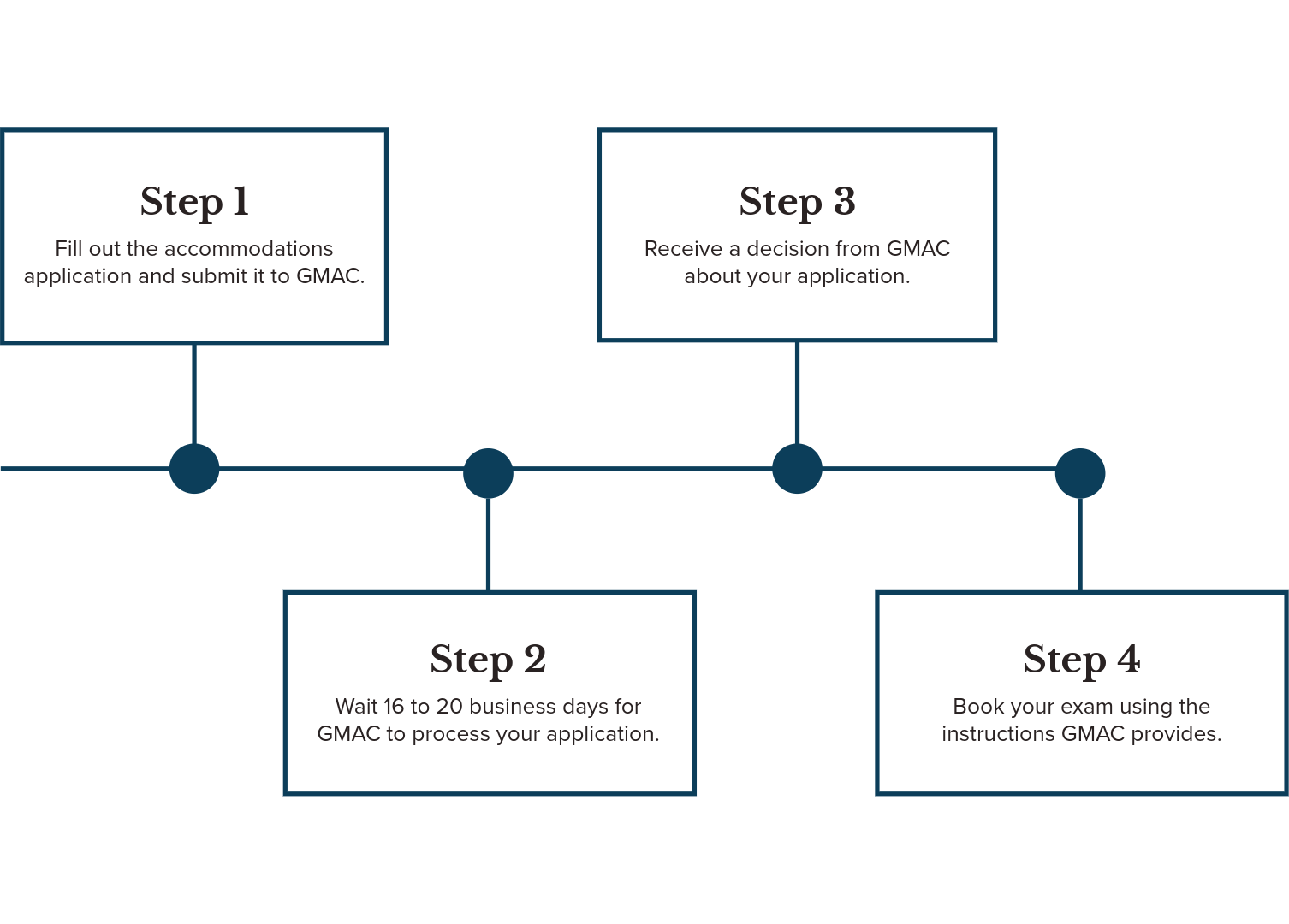
The application process itself is straightforward.
-
- Read the GMAT Supplement for Test Takers with Disabilities. This document explains what GMAC needs for your specific situation. Don’t worry if you don’t see your exact condition listed. As long as you submit a complete, well-documented request, GMAC will review it.
- Gather your documentation from a qualified professional. If you already work with a doctor, psychologist, or other specialist for your condition, ask them to prepare a formal accommodation letter. Provide them the supplement and a list of the accommodations you’re requesting so their assessment aligns with GMAC’s requirements. If that isn’t feasible, gather the documentation you already have.
- Complete the request form. Most of the form consists of straightforward questions about your condition and any previous accommodations you’ve received. Pay particular attention to the Accommodations Rationale section, where you’ll explain how your condition affects your testing experience and why the specific accommodations you’re requesting are necessary. Take your time with this section.
- Attach your medical documentation at the bottom of the form, and submit.
You can find the Supplement, the request form, and the Apply for Accommodations button on GMAC’s testing accommodations page.
A few practical tips:
- Every field except the Accommodations Rationale has a 255-character limit, so be concise.
- mba.com logs users out after about 20 minutes of inactivity. If the form takes a while, save your responses into a separate document so you don’t lose your work.
- Within about 24 hours of submitting your request, it should appear in your mba.com account. If it doesn’t, contact GMAC’s accommodations team to confirm that your submission was received before submitting again.
Once a decision is issued, you’ll receive an email notification and your account will be updated. Approved accommodations are valid for two years, and your decision letter will explain how to schedule your exam with those accommodations in place.
Starting your GMAT journey and wondering how to get started? Our free GMAT Starter Kit paves the way so you start your prep the right way.
DownloadFour Big Myths About GMAT Accommodations
Many test-takers hesitate to apply for accommodations because of common misconceptions. We interviewed Jason Northrup, GMAC’s Senior Manager of Testing Accommodations, about the myths he encounters most often. Here were his responses:
- “Business schools will find out.”
They won’t. Business schools do not see whether you tested with accommodations or not. There is no flag on your score report, and your medical information is treated as private health data. - “Accommodations give me an unfair advantage.”
The purpose of accommodations is to level the playing field, not tilt it. The GMAT is designed to measure reasoning skills, not your ability to sit still with ADHD or push through PTSD symptoms under time pressure. Accommodations help ensure that the exam measures your abilities rather than the effects of your condition. - “Other people cheat the system.”
Fraud is extremely rare. Every accommodations request is reviewed by experts, and GMAC works with testing and security specialists to identify suspicious cases. - “The process is too complicated and expensive.” GMAC does not require new, costly evaluations unless they are truly necessary. In many cases you can submit documentation you already have, along with an explanation of how your condition affects your performance under standard testing conditions.
Still Unsure About GMAT Accommodations? Let’s Break Down the 4 Biggest Myths
Frequently Asked Questions
How long does GMAC take to review my accommodations application?
Plan for up to 16–20 business days. Because you cannot schedule an accommodated exam until your request is approved, it’s best to apply as early as possible so the review process doesn’t interfere with your testing or application deadlines.
What if I was denied accommodations before, such as on the SAT or ACT?
A prior denial does not automatically disqualify you. GMAC evaluates each request individually, and in many cases, if documentation is incomplete or additional information is needed, applicants are given an opportunity to provide it rather than receiving an immediate denial.
Can I apply if I already took the GMAT without accommodations?
Yes. You can apply for accommodations at any time. Just keep in mind that accommodations cannot be applied retroactively, so they will only affect exams you take after your request is approved.
Are accommodations available for the online GMAT?
Yes. Most accommodations, including 50% and 100% extra time and additional breaks, are available for both the test center and online formats. For a detailed comparison of the two testing options, see: GMAT Test Online vs. In-Person.
How long are accommodations valid?
Approved accommodations remain valid for two years from the date of the decision. Any GMAT exams you take during that period can be scheduled with your approved accommodations in place.
Do I need to apply separately for the Executive Assessment?
Yes. Accommodations for the GMAT and the Executive Assessment are administered separately. If you already have a GMAT approval, you can usually streamline the EA request process by including a copy of your GMAT decision letter with your request.