

What Is the Executive Assessment?

The Executive Assessment (EA) is a 90-minute standardized test you can use to apply to business school. It’s built for working professionals, typically people applying to executive MBA, part-time MBA, or online MBA programs who don’t want to (or don’t need to) sit for the full GMAT. The EA tests the same core skills as the GMAT: quantitative reasoning, verbal reasoning, and data interpretation, but in a shorter, more concentrated format.
If you’re researching the EA for the first time, this article covers what’s on it, how it’s scored, and what you actually need to know before you register.
Who Is the Executive Assessment For?
The EA was designed to serve the needs of busy working professionals. GMAC, the organization that makes the test, describes it as “designed specifically for busy, experienced professionals” and claims it “requires minimum preparation.”
The “minimum preparation” claim is mostly about the test’s length and format. At 90 minutes long, the EA is significantly shorter than the GMAT, and the question types will feel familiar if you’ve been working with numbers and reading complex material throughout your career. If your quantitative and verbal skills are reasonably sharp from years of professional work, you may not need months of dedicated study. But “minimum preparation” doesn’t mean “no preparation,” and if your math is rusty or you haven’t done timed standardized testing in a decade, you’ll want to invest some study time before sitting for the exam.
The EA is primarily accepted by executive, part-time, and online MBA programs, although a growing number of full-time programs are beginning to accept it as well. That said, if you’re targeting competitive full-time MBA programs, the GMAT or GRE® is usually the stronger choice. Those programs are more familiar with GMAT and GRE® scores, and submitting an EA score to a program that clearly prefers the GMAT can raise questions about why you didn’t take the more established exam.
To check whether your target programs accept the EA, look at the application requirements on each school’s website. GMAC also maintains a list of schools that accept the EA. For a deeper look at whether the EA makes sense for your situation, see Who Should Take the Executive Assessment?
How the EA Is Structured
The EA has three sections, each 30 minutes long: Integrated Reasoning, Verbal Reasoning, and Quantitative Reasoning. There is no essay. The total testing time is 90 minutes.
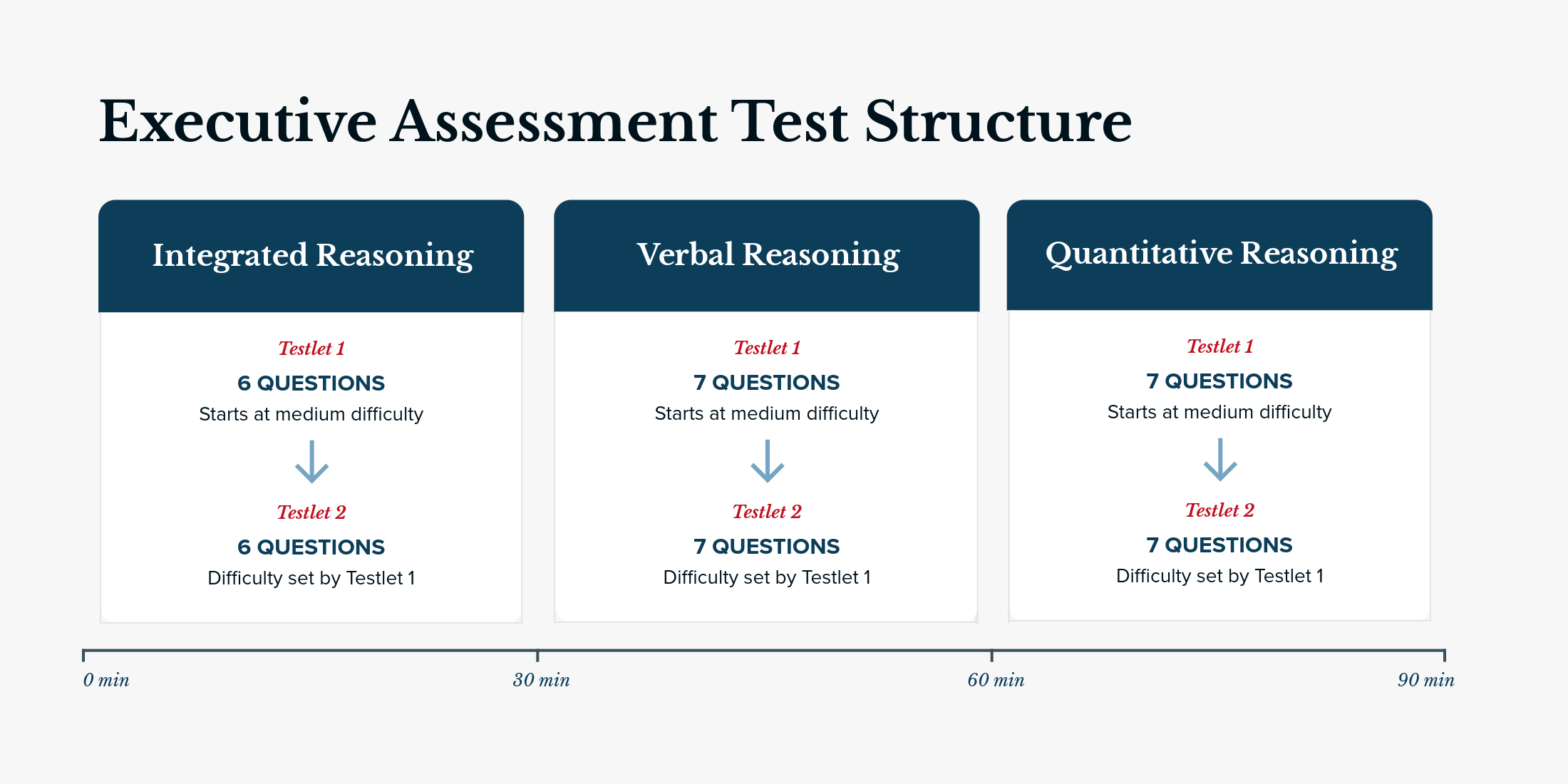
Each section is divided into testlets, small batches of questions that you can navigate within. You can move forward and backward within a testlet, skip questions, and come back to them before you finish that batch. Once you complete a testlet and move to the next one, you can’t go back.
The EA is adaptive between testlets. After you finish your first testlet in a section, the exam adjusts the difficulty of your next testlet based on how you performed. If you do well, you’ll get harder questions. If you struggle, you’ll get easier ones. This is the same basic approach the GMAT uses, just applied at the testlet level rather than question by question.
The section order is fixed: Integrated Reasoning comes first, then Verbal, then Quant.
What’s on Each Section
For an in-depth look on what’s on each section, visit: What’s on the Executive Assessment.
Integrated Reasoning
The Integrated Reasoning (IR) section presents data in tables, charts, and written passages, sometimes combining all three, and asks you to draw conclusions. There are four question types:
- Multi-Source Reasoning gives you two or three tabs of information (text, tables, charts, or some combination) and asks questions that require pulling data from more than one tab. The challenge isn’t any single piece of information, but instead, figuring out what information to pay attention to and how the data relates to one another.
- Table Analysis gives you a sortable data table and a series of true/false statements. You need to sort through the data and evaluate each statement.
- Graphics Interpretation shows you a graph or chart and asks you to complete statements using dropdown menus. The graphs can be straightforward or quite outlandish, so don’t anticipate seeing only basic bar and line graphs for this one.
- Two-Part Analysis gives you a problem with two connected parts. You select one answer for each part from a shared set of options. These can be quantitative, verbal, or a mix. The two parts of each question are usually interdependent – get one part wrong, and you’ll probably get the other part wrong too.
If you’ve only practiced traditional multiple-choice questions, the formats of IR questions can feel unfamiliar at first, but don’t let that throw you off. The underlying skills for this section are the same ones tested everywhere else on the EA: read carefully, interpret data accurately, and don’t rush.
Verbal Reasoning
The EA verbal section is 14 questions in 30 minutes: 6 Sentence Correction, 4 Critical Reasoning, and 4 Reading Comprehension. For the full breakdown of how the verbal section works and how to approach it, see EA Verbal: What’s on It, How It’s Scored, and How to Prepare.
- Reading Comprehension gives you a passage (usually a few paragraphs) and asks questions about it. Some test basic understanding, others ask you to draw inferences or identify the author’s purpose.
- Critical Reasoning gives you a short argument and asks you to do something with it: strengthen it, weaken it, identify an assumption, or find a flaw. These questions reward logical thinking. You need to see the structure of the argument clearly enough to figure out what would make it better or worse.
- Sentence Correction gives you a sentence with an underlined portion and five versions of that portion. Your job is to pick the one that’s grammatically correct and logically clear.
If you’re familiar with the GMAT, Sentence Correction may have made you do a double-take. Yes, the EA still has Sentence Correction, even though the current GMAT has dropped it.
The core skill being tested on EA verbal isn’t grammar. It’s precise reading and reasoning. If you rush through and read sloppily, you’ll struggle on all three question types.
For an in-depth guide on how to tackle EA Verbal, see our full guide here.
Quantitative Reasoning
The EA Quantitative Reasoning section tests your ability to reason through quantitative problems, not your ability to recall formulas.
The following are some of the most common math topics that appear on the EA quant section, tested at the ninth- or tenth-grade level.
- Arithmetic
- Algebra
- Exponents
- Percents
- Ratios
- Rates
- Probability
- Combinatorics
- Statistics
- Number Properties
Something to note: there is no geometry on the EA, though you might see some questions involving coordinate planes, as the creators of the exam consider that to be part of algebra.
The difficulty of questions on EA Quant isn’t from how advanced the math is, it’s from how the questions are constructed. The question writers rarely ask you a straightforward question – instead, they give you a problem where the solution isn’t necessarily clear, and leave it up to you to discern the most efficient and elegant method to arrive at the correct answer.
The quant section uses two question formats: Problem Solving (traditional multiple choice) and Data Sufficiency. Data Sufficiency is unique to the GMAT and EA. Instead of solving a problem, you’re given two statements and asked whether they provide enough information to answer the question. You don’t actually need to find the answer, you just need to determine whether you have enough information to answer what the question asks of you.
How to prepare for the Executive Assessment
How the EA Is Scored
The EA is scored on a scale of 100 to 200. GMAC puts a score of 150 at roughly the 64th percentile, which means the actual median sits below 150. You also receive individual section scores for IR, Verbal, and Quant.
Uniquely, business schools don’t evaluate your score the same way they would a GMAT or GRE® score. Schools evaluate your score on readiness bands, which are broad categories like “ready,” “borderline,” or “needs development,” to evaluate whether you can handle the academic workload.
Once you’re above roughly 155 to 156 overall, further gains often don’t make much practical difference in admissions, because you’ve met the criteria of academic readiness, and schools move on to other parts of your application. This makes the EA more of a threshold test than a ranking test.
This is important because it affects how you should study. If a practice test puts you near or above your target score, don’t spend weeks trying to squeeze out a few more points, because you’ve already met the criteria. Your time is probably better spent on your application essays, resume, and interview prep. If your score is well below where it needs to be, that’s when you should put in the elbow grease to increase it.
For the full picture on how scoring works, including section scores and what programs actually look for, see How is the Executive Assessment Scored?
Taking the EA: Test Center vs. Online
You can take the EA at a Pearson VUE test center or online from home. The exam is exactly the same in both settings, so this is purely a logistics decision.
Taking the test at home makes sense if test centers near you are inconvenient or fully booked, or if you think you’ll be calmer in your own space. You’ll need a computer with a webcam, a stable internet connection, and a quiet room where you won’t be interrupted. GMAC has specific requirements for your testing environment, and they’re stricter than you might expect, so read them carefully before you commit.
Taking the test at a center makes sense if your internet at home is unreliable, if you’re worried about distractions, or if you just prefer having a controlled testing environment. The center provides a note board and marker, and you don’t have to worry about a doorbell or a dog ruining your concentration.
Registration, Cost, and Retakes
You register for the EA through mba.com. The registration fee is $350. Rescheduling policies are somewhat friendlier than the GMAT’s, but you’ll still want to book well in advance if you need a specific date or test center location.
You can take the EA up to six times in your lifetime (three times in person, three times online), and your scores are valid for five years. If you’re planning to retake, give yourself enough time between attempts to actually address whatever held your score back the first time. Retaking without changing your preparation rarely changes the outcome.
EA vs. GMAT: Which Should You Take?
If your target programs accept the EA and you’re applying to executive or part-time programs, the EA is usually the more efficient choice. It’s shorter, the question types overlap with the GMAT, and the preparation timeline is more realistic for working professionals.
If you’re applying to a mix of program types, some of which prefer the GMAT, you may need to take both exams or take the GMAT/GRE® and use it everywhere. The decision depends on your specific list of schools. For the detailed comparison, see our article comparing the EA, GMAT, and GRE®.
Frequently Asked Questions
How long is the Executive Assessment?
90 minutes of testing time, split into three 30-minute sections: Integrated Reasoning, Verbal, and Quant. There is no essay.
How much does the Executive Assessment cost?
The registration fee is $350. Rescheduling and cancellation policies are listed on mba.com.
What’s a good EA score?
It depends on your target programs. GMAC puts a score of 150 at roughly the 64th percentile on the 100-200 scale. Many executive and part-time programs use readiness bands rather than strict cutoffs, and once you’re above roughly 155-156 overall, further gains may not affect your admissions outcome. Check your programs’ reported averages.
Is the Executive Assessment the same as the GMAT?
No. The EA uses some of the same question types, but it’s shorter (90 minutes vs. roughly two and a quarter hours), scored on a different scale (100-200 vs. 205-805), and used differently by admissions committees. The EA also still includes Sentence Correction, which the current GMAT has dropped.
How many times can I take the EA?
Six times in your lifetime – three times in person, three times online. Your scores are valid for five years.
Can I take the Executive Assessment online?
Yes. You can take it at a Pearson VUE test center or online from home. The exam content is identical in both settings.
Does the EA have geometry?
No, there are no geometry questions on the EA. You may see questions involving coordinate planes, but those are filed under algebra.
Does the EA have Sentence Correction?
Yes. Unlike the current GMAT, the EA still includes Sentence Correction as part of the verbal section. See our Beginner’s Guide to EA Sentence Correction.