

GMAT Quantitative Reasoning: A Complete Guide

The GMAT Quantitative Reasoning section consists of 21 Problem Solving questions in 45 minutes, scored on a scale from 60 to 90, with no calculator allowed. Every question is multiple-choice, the difficulty adapts to your performance, and the math itself never goes beyond high school level. What makes GMAT quant hard isn’t the content, it’s the reasoning: the exam twists familiar topics into unfamiliar logic puzzles under time pressure. This guide covers what’s on the section, how it’s scored, and how to prepare for it.
What Is on the GMAT Quantitative Reasoning Section?
GMAT quant consists of 21 Problem Solving questions, and you have 45 minutes to complete them. Problem Solving is the only question type in the section: you’re given information, asked to solve for an unknown value or outcome, and choose the best answer from five options.
If you’ve seen older prep materials mention Data Sufficiency, note that those questions now live in the Data Insights section, not in quant. For how quant fits into the full exam, see What Is on the GMAT?, and for everything that changed in the current version, see What’s Different About the Current GMAT?
One more thing: you’re not allowed a calculator on GMAT quant. The on-screen calculator exists only in Data Insights. That’s a deliberate design choice, because the section is built so that clean reasoning beats brute-force arithmetic every time.
What Math Topics Are on GMAT Quant?
The core of your GMAT quant score is algebra (linear equations, quadratics, inequalities), arithmetic (exponents, roots, estimation), and a few key flavors of word problems (percents, ratios, algebraic translations). Those unglamorous topics appear in more than two-thirds of quant questions.
Some of the topics students fear most, such as probability, combinatorics, and the infamous two-trains rate problems, each show up in fewer than 3% of GMAT questions. And there’s no geometry on the current GMAT. If your study plan is weighted toward the exotic topics, your math anxiety is pointed at the wrong target.
Quantitative Reasoning Is Not Math
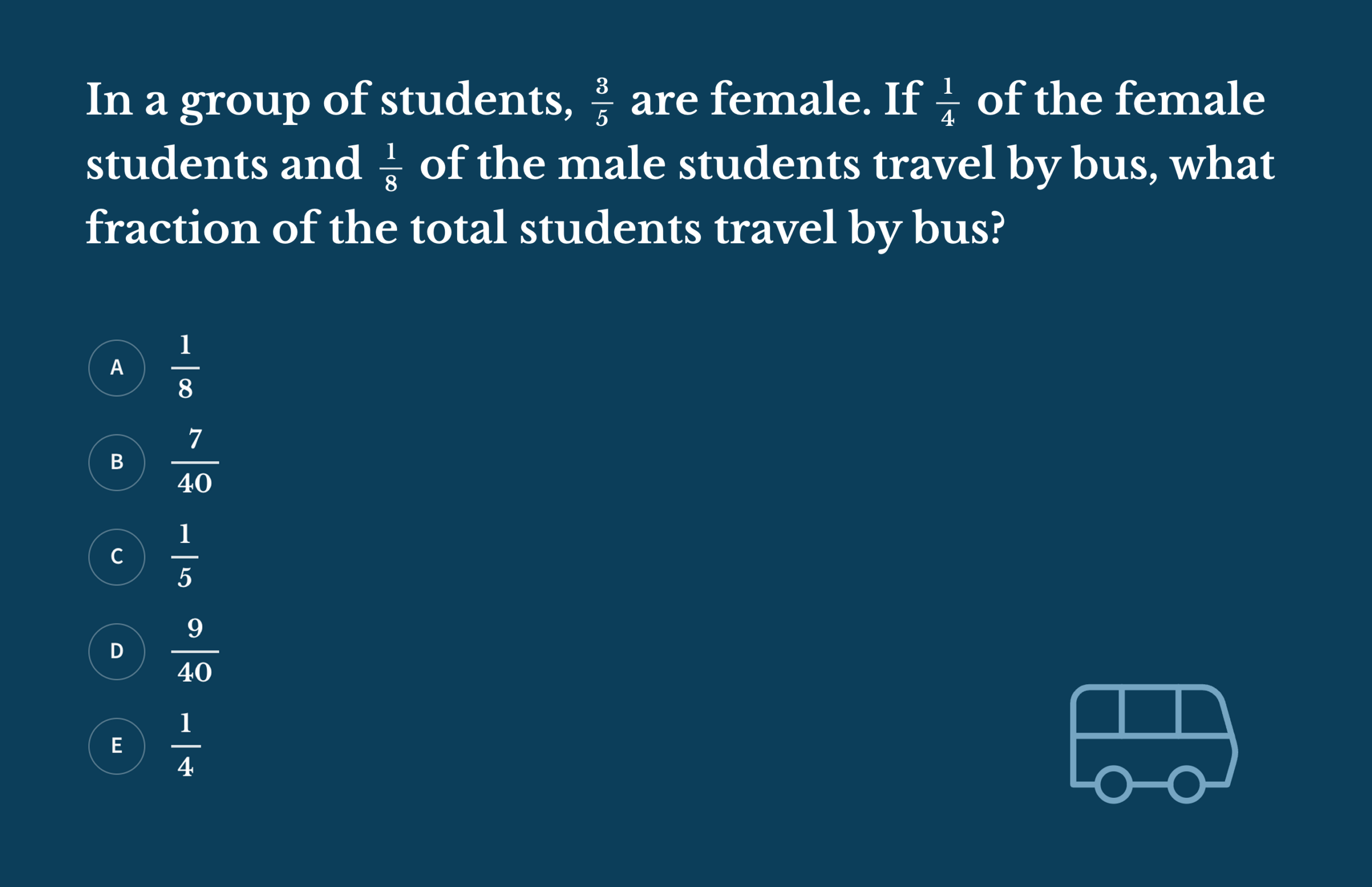
GMAC’s own psychometricians insist that there is no “math section” on the GMAT, only quantitative reasoning, and the distinction is important. Students who treat GMAT quant as memorized steps get eaten alive by questions designed to punish mechanical thinking, while students who search for flexible, logical solution paths thrive on the very same questions. If you’ve ever said “I’m good at math, so why is GMAT quant so hard for me?”, read GMAT Quantitative Reasoning Is Not GMAT Math.
How Is GMAT Quant Scored?
Your Quantitative Reasoning score runs from 60 to 90, in one-point increments, and combines equally with Verbal and Data Insights to form your total score on a scale from 205 to 805. The quant section is adaptive: answer correctly and the questions generally get harder; answer incorrectly and the questions tend to get easier.
The scoring consequence: because the algorithm weighs question difficulty, a careless miss on an easy question hurts you far more than a miss on a hard one. What matters is which questions you miss, not just how many you miss.
You can estimate how section scores combine to form your composite score with our GMAT score calculator, and the full mechanics of the scoring algorithm can be found in GMAT Scoring Explained.
How to Master GMAT Problem Solving
Mastering the section comes down to four skills: accuracy on the core topics, eliminating careless mistakes, wise time management, and a flexible mindset. The highest-leverage habit is a simple routine: read every question twice, plan your path before you calculate, and check your work as you go. We break down all four skills, with a worked example, in How to Master GMAT Problem Solving.
Timing: The Simplest Strategy That Actually Works
The best quant timing strategy barely deserves to be called a “strategy” at all: if you read a question twice and don’t see an efficient solution path, guess and move on, then spend the time you save being ridiculously accurate on the questions you understand.
One of our students rode that single habit to a nearly 40-percentile-point quant jump in four weeks. Her story and strategy can be found in GMAT Timing “Strategy” for Quant.
Breaking Into the Elite Quant Range
As they try to climb past an 80 on quant, too many students change their strategy for the worse. They often invest extra time chasing the very hardest questions, thinking that the nastiest problems are their only remaining barrier to an elite score.
Unfortunately, this can work against you. If you sink too much time into the toughest quant questions, odds are good that you’ll start rushing through the easier questions, exposing yourself to careless mistakes.
The irony? If you have the potential for an elite score, a single careless miss on a not-terribly-hard question costs far more than a mistake on a hard question.
To help hone your strategy as you try to break into the elite score range, start with How to Improve Your GMAT Quant Score Above 80.
How to Study for GMAT Quantitative Reasoning
Prep for quant the way you’d prep for the exam as a whole: take a cold official practice test, figure out what’s actually costing you points (it’s usually accuracy on core topics or careless errors, not missing knowledge of exotic topics), improve those specific weaknesses using official questions, and verify progress with another practice test only after your homework data improves. Click here for the full framework on how to improve, or build your own study plan and schedule.
And one final note: you don’t need a long, elaborate formula sheet for GMAT Quant. Because the GMAT is a test of your reasoning ability, it’s not very interested in how well you memorize formulas. Reasoning is a fundamentally different skill than recalling formulas on command – during your prep, you’ll want to train the former, not the latter. In fact, memorizing too many formulas can make you objectively worse at the exam, not better. We go into more detail about our philosophy around formulas here.
Frequently Asked Questions
What is GMAT Quantitative Reasoning?
It’s the GMAT’s quant section, with 21 multiple-choice Problem Solving questions in 45 minutes, scored from 60 to 90. It tests reasoning skills rooted in high-school-level math, not advanced mathematics.
How many questions are on the GMAT quant section?
21 questions in 45 minutes, all of which are Problem Solving. Data Sufficiency questions are part of the Data Insights section on the current GMAT.
Can you use a calculator on GMAT Quantitative Reasoning?
No. The on-screen calculator is available only in the Data Insights section. Quant questions are designed to be solved with reasoning, algebra, estimation, and clean arithmetic.
Is GMAT quant hard?
The math content is high school level, so the difficulty comes from reasoning under time pressure, not the topics themselves. How hard it feels depends mostly on the gap between your current skills and your target score.